
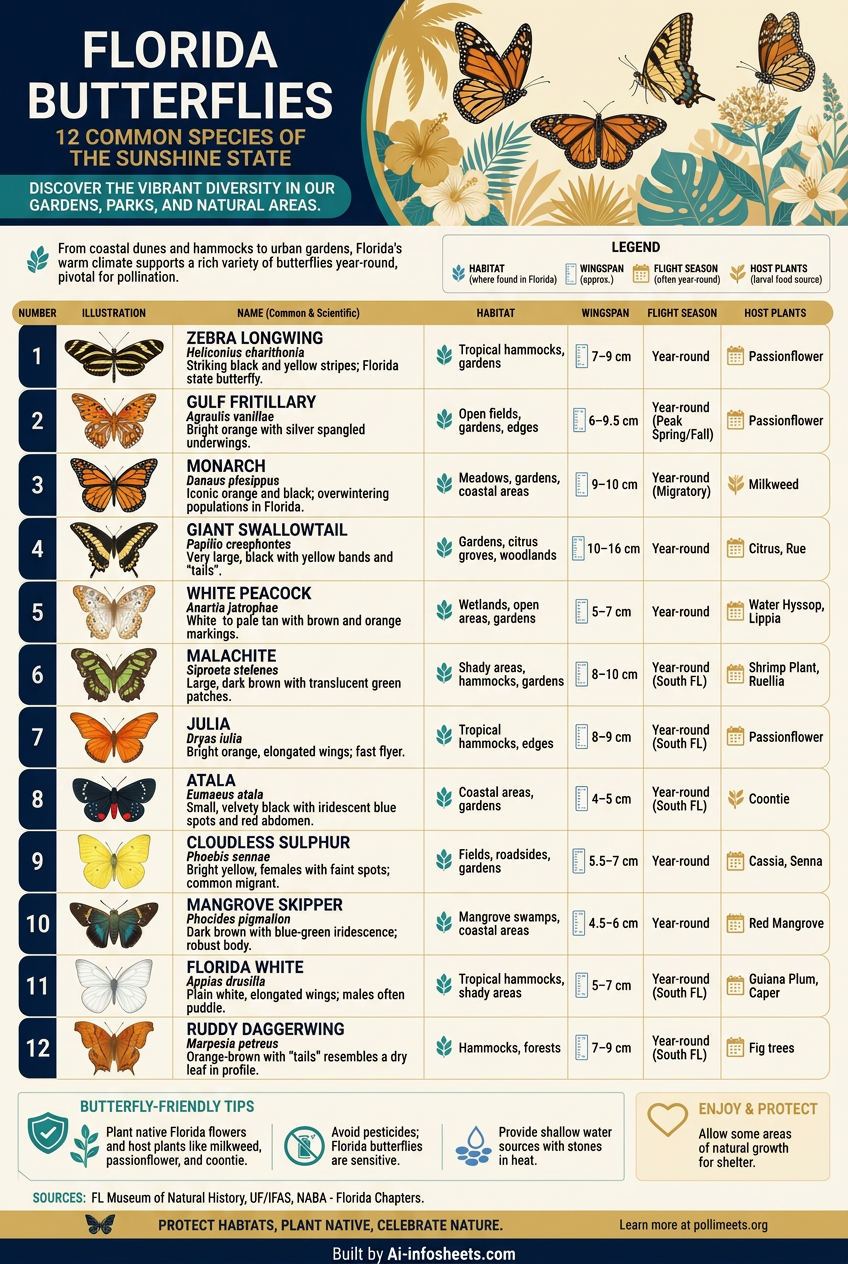
Florida's warm climate and diverse ecosystems create an ideal habitat for an incredible array of butterfly species, making it a prime location for butterfly enthusiasts and nature lovers alike. These delicate insects play a crucial role as pollinators, contributing significantly to the health and biodiversity of our floral landscapes. With over 200 species recorded in the state, encountering these vibrant creatures is a common and joyful experience. This guide spotlights the ten most frequently observed butterfly species across Florida, offering key identification features to help you distinguish them and appreciate their unique contributions to the environment.
Discovering Florida's Common Butterfly Species
Florida's rich biodiversity supports a wide variety of butterfly species, each with distinct markings, behaviors, and preferred host plants. Understanding these characteristics not only aids in identification but also highlights the intricate connections within their ecosystems. From migratory marvels to local garden residents, these butterflies are essential components of Florida's natural heritage.
1. Monarch (Danaus plexippus)
Perhaps the most recognizable butterfly, the Monarch is famous for its vibrant orange and black wings, distinctive white spots on the wing margins, and impressive migratory journeys. In Florida, Monarchs can be observed year-round, with some populations migrating south for the winter along the state's coasts. Their caterpillars exclusively feed on milkweed plants, making these critical for their survival.
2. Zebra Longwing (Heliconius charithonia)
Designated as Florida's state butterfly, the Zebra Longwing is easily identified by its elongated black wings adorned with narrow yellow stripes. These butterflies have a unique characteristic among butterflies: they consume pollen in addition to nectar, which provides them with amino acids and increases their lifespan. They are common throughout the state and are often seen flitting around shaded areas. Their primary host plant is the passionflower vine.
3. Gulf Fritillary (Agraulis vanillae)
The Gulf Fritillary is a medium-sized butterfly with bright orange wings featuring black markings and distinctive silvery-white spots on the underside. They are very common in Florida, especially in gardens and open fields where their host plant, passionflower, grows abundantly. These butterflies are active fliers and are attracted to a wide variety of nectar sources.
4. Eastern Tiger Swallowtail (Papilio glaucus)
One of the largest and most striking butterflies in Florida, the Eastern Tiger Swallowtail exhibits sexually dimorphic coloration. Males are typically bright yellow with four black 'tiger' stripes on each forewing, while females can be either yellow or a dark black form. They are generalists in terms of habitat and nectar sources, and their caterpillars feed on various tree leaves, including wild cherry, sweet bay, and ash.
5. Cloudless Sulphur (Phoebis sennae)
The Cloudless Sulphur is a common sight in Florida, particularly in open, sunny areas. Males are a bright, uniform yellow, while females are typically a paler yellow, sometimes with a few small black spots. As their name suggests, they lack dark markings on their upper wings, distinguishing them from other sulphur species. Their caterpillars feed on plants in the pea family, such as senna.
6. Viceroy (Limenitis archippus)
The Viceroy butterfly closely mimics the Monarch, a classic example of Batesian mimicry. While similar in appearance with orange and black wings, the Viceroy can be distinguished by a black horizontal line across the hindwings. They are slightly smaller than Monarchs and prefer wetter habitats around willows, their primary host plant. Viceroys are found statewide, especially near wetlands.
7. Red-spotted Purple (Basilarchia arthemis astyanax)
This subspecies is frequently observed in Florida and is recognized by its iridescent blue-black wings, often with red-orange spots near the hindwing margins on the underside. They share similarities with the Spicebush Swallowtail but lack the 'tails'. Their caterpillars feed on a variety of trees, including wild cherry, willow, and poplar. They are often found in wooded areas and along forest edges.
8. Common Buckeye (Junonia coenia)
The Common Buckeye is easily identified by the prominent, striking 'eyespots' on both its forewings and hindwings. These eyespots are thought to deter predators. Their wings are predominantly brown with orange and white markings. They are adaptable butterflies found in various open habitats. Their caterpillars feed on plants such as plantain, snapdragon, and false foxglove.
9. Painted Lady (Vanessa cardui)
The Painted Lady is a highly migratory butterfly found worldwide, including throughout Florida. Its wings are orange and brown with black and white spots, featuring a distinctive row of four small eyespots on the hindwing. These resilient butterflies are opportunistic and use a wide range of host plants for their caterpillars, including thistles, mallows, and legumes.
10. Florida Duskywing (Ephyriades brunnea floridensis)
The Florida Duskywing is a small, dark-brown butterfly belonging to the skipper family. While not as vividly colored as some other species, it is notable for its rapid, erratic flight. This species is unique to Florida and is often found in hammocks and pine rocklands. Its caterpillars feed on the plant _Ziziphus celata_, a deterrent for pests and deer. The butterfly itself has been designated as an endangered species by the state of Florida due to habitat loss.
These ten common Florida butterfly species represent just a fraction of the state's rich lepidopteran diversity. Learning to recognize them is the first step in appreciating their beauty and understanding their ecological importance. Consider planting native host and nectar plants to attract and support these vital pollinators in your own backyard. Your efforts contribute directly to their conservation.