
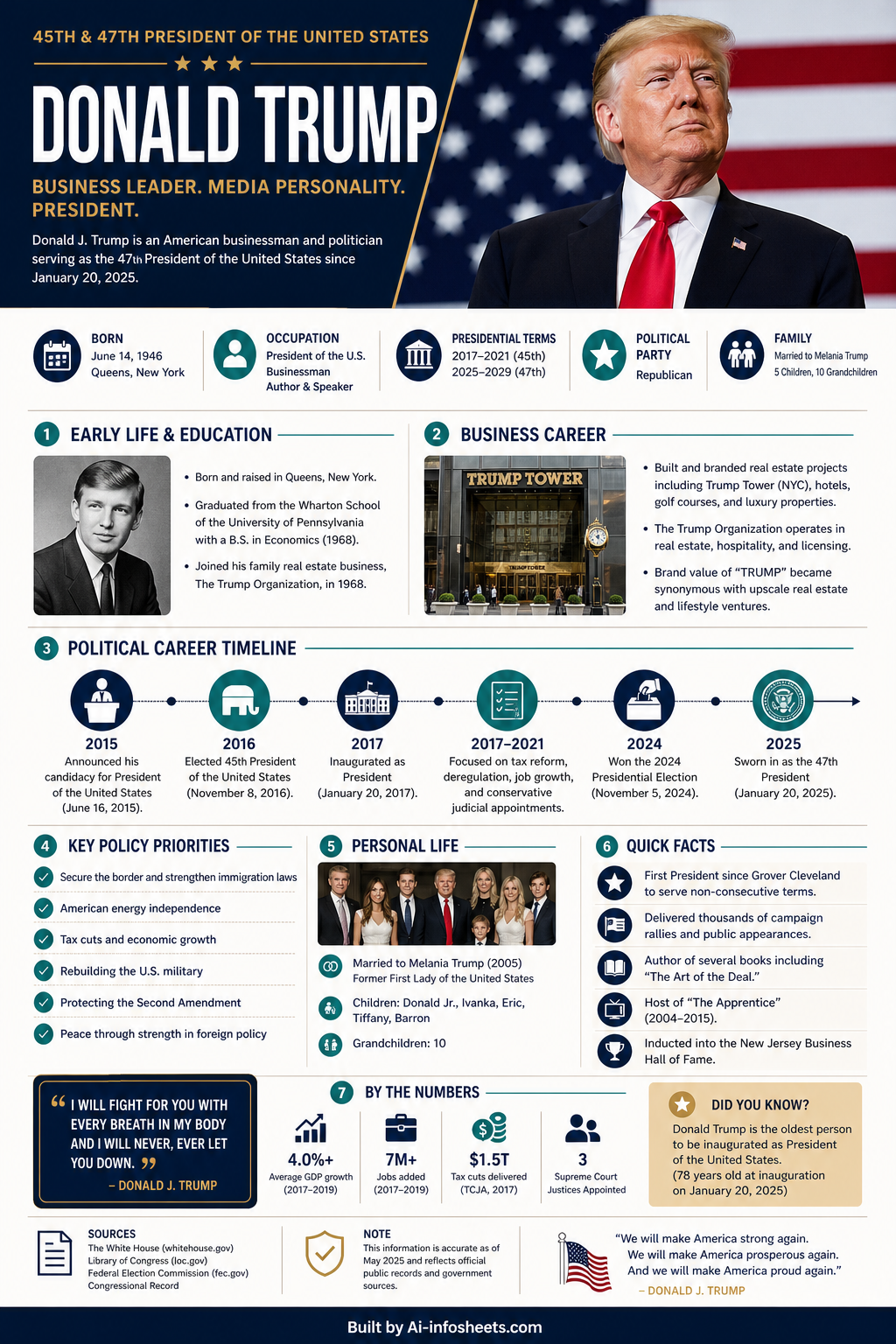
Donald J. Trump's political ascent from a prominent real estate developer and television personality to the 45th President of the United States redefined contemporary American politics. His presidency, spanning from January 2017 to January 2021, was marked by a distinctive populist approach, a focus on economic nationalism, and a challenge to established political norms. This period saw significant policy changes impacting various sectors, from trade and immigration to healthcare and foreign relations, sparking extensive debate and leaving a profound imprint on the nation's political landscape.
Early Career and Political Rise
Donald J. Trump began his career in his family's real estate business in New York City, eventually taking over as chairman and president of The Trump Organization. He expanded the company's portfolio to include hotels, casinos, and golf courses, building a brand synonymous with luxury and ambition. His public profile grew further with the success of his reality television show, 'The Apprentice,' which first aired in 2004. Trump's entry into presidential politics was not his first, as he had explored bids in the 1980s and 2000s, but his 2016 campaign, characterized by unconventional rhetoric and direct appeals to a broad base of disaffected voters, ultimately led to his victory.
The Trump Presidency (2017-2021)
Upon taking office in January 2017, Donald Trump embarked on an ambitious agenda centered on his 'America First' philosophy. His administration focused on deregulation, tax reform, and a renegotiation of international trade agreements. The presidency was often characterized by a direct communication style through social media, frequent rallies, and a willingness to challenge long-standing political traditions and institutions.
Economic Policies
The Trump administration enacted significant tax reforms with the Tax Cuts and Jobs Act of 2017, which reduced corporate and individual income tax rates (Source: White House Archives). Proponents argued these cuts would stimulate economic growth, while critics raised concerns about their impact on the national debt. During his term, the U.S. economy experienced low unemployment rates, and the Dow Jones Industrial Average reached new highs. The administration also pursued a strategy of trade protectionism, imposing tariffs on goods from countries like China and initiating renegotiations of agreements such as NAFTA, which was replaced by the USMCA (Source: U.S. Trade Representative).
Immigration and Border Security
Immigration policy was a cornerstone of Trump's agenda, with a strong emphasis on border security. His administration sought to build a wall along the U.S.-Mexico border and implemented stricter enforcement measures. Executive orders were issued to impose travel restrictions on citizens from several Muslim-majority countries, sparking widespread legal challenges and protests (Source: American Civil Liberties Union). The 'zero tolerance' policy at the border led to family separations, drawing international condemnation, though the policy was later rescinded.
Foreign Policy and International Relations
In foreign policy, Trump adopted an 'America First' approach, prioritizing perceived national interests over multilateralism. He withdrew the U.S. from the Paris Agreement on climate change and the Iran nuclear deal (Source: United Nations). His administration also initiated efforts to normalize relations between Israel and several Arab nations through the Abraham Accords and engaged in high-profile summits with North Korean leader Kim Jong Un over denuclearization. Relations with traditional allies sometimes strained, while engagement with adversaries took new forms.
Healthcare and Social Issues
Repealing and replacing the Affordable Care Act (ACA) was a primary promise of Trump's campaign. Despite multiple attempts, his administration was unsuccessful in passing new healthcare legislation, though it did take steps to weaken the ACA through executive actions. On social issues, Trump appointed three conservative justices to the Supreme Court—Neil Gorsuch, Brett Kavanaugh, and Amy Coney Barrett—shifting the court's ideological balance (Source: Supreme Court of the United States).
Post-Presidency Activities and Legacy
Following his departure from office in January 2021, Donald Trump remained a central and influential figure in American politics. He continued to hold rallies, endorse political candidates, and engage in public discourse, solidifying his role as a leading voice within the Republican Party. His post-presidency era has been characterized by ongoing legal challenges and a continuous effort to shape the national narrative and future political elections. Trump's legacy is complex and contested, with supporters praising his economic policies, judicial appointments, and willingness to challenge the status quo, while critics point to his rhetoric concerning democratic institutions, social divisions, and foreign policy decisions. His impact on the Republican Party, American political polarization, and the discourse surrounding media and truth will likely be subjects of debate and analysis for years to come.
Donald J. Trump's time in the White House and his continued presence in the political arena have undeniably reshaped the landscape of American governance and public life. Understanding his policy decisions, communication style, and the broad public reaction is essential for grasping contemporary U.S. politics. Explore these facets further to form a comprehensive understanding of the Trump era and its lasting implications.