
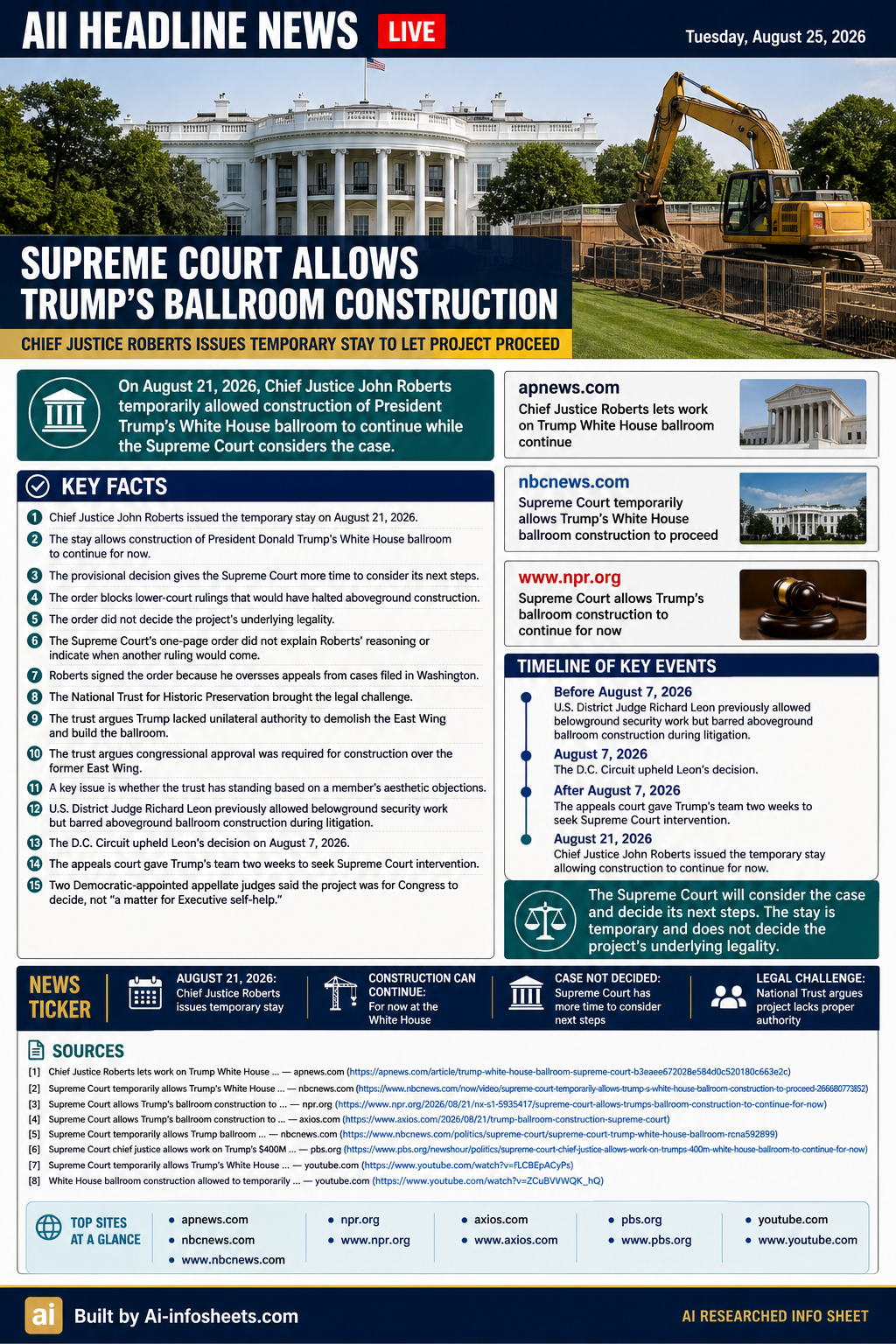


On August 21, 2026, Chief Justice John Roberts issued a significant administrative stay, temporarily permitting the continuation of above-ground construction for a new White House ballroom. This pivotal decision emerged amidst intense litigation, primarily initiated by the National Trust for Historic Preservation, which questioned the executive branch's authority to undertake such a project without explicit congressional approval. The stay effectively paused a lower-court order that had halted above-ground work, allowing the Supreme Court additional time to consider the complex legal and historical implications of the development.
The Supreme Court's Decision
Chief Justice John Roberts issued a temporary stay on August 21, 2026, which allows the ongoing construction of a White House ballroom to proceed. This provisional decision does not rule on the project's legality but rather provides the Supreme Court with additional time to deliberate on the case and its next steps. The order specifically blocked earlier lower-court rulings that would have stopped above-ground construction, ensuring that work could continue while the litigation progresses.
Legal Challenges and Arguments
The National Trust for Historic Preservation has been at the forefront of the legal challenge against the White House ballroom construction. The Trust argues that the executive branch lacked the unilateral authority to demolish the former East Wing of the White House to make way for the new ballroom. They contend that such a significant project requires explicit congressional authorization, especially given the historical importance of the site. A key aspect of the legal dispute also revolves around whether the National Trust has the necessary standing to sue, based on aesthetic objections from its members.
Timeline of Key Events
Before August 7, 2026
Prior to this date, U.S. District Judge Richard Leon had permitted below-ground security work for the project but had explicitly barred above-ground ballroom construction during the ongoing litigation. This earlier ruling recognized the need for security enhancements while scrutinizing the broader construction plans.
August 7, 2026
On this date, the D.C. Circuit Court of Appeals upheld Judge Leon's decision, affirming the prohibition on above-ground construction. This appellate ruling reinforced the legal challenge against the project and set the stage for further action.
After August 7, 2026
Following the D.C. Circuit's affirmation, the appeals court granted the Trump administration's legal team a two-week window to seek intervention from the Supreme Court. This period was crucial for the administration to prepare its appeal and present its case to the highest court.
August 21, 2026
Chief Justice John Roberts issued the temporary stay on this day, effectively overturning the lower court's block on above-ground construction. This administrative stay allows the construction of the White House ballroom to continue temporarily, pending a full review by the Supreme Court. The Chief Justice's one-page order did not elaborate on the reasoning behind his decision or indicate when the full Court would issue a more comprehensive ruling.
Project Scope and Administration's Stance
The administration has described the project as an integrated military complex, featuring a secure ballroom vital for national security and presidential safety. Officials have emphasized the project's strategic importance, arguing that it's not merely an aesthetic addition but a critical infrastructure upgrade. The National Trust, however, has accused the administration of attempting to accelerate construction to preempt and "outrun judicial review," a claim that underscores the contentious nature of the project. The administration reported the overall project was 65% complete as of the week before the Supreme Court’s order, with 250 workers engaged in intensive 20-hour daily, seven-day weekly shifts.
This temporary stay ensures that construction can continue while the Supreme Court prepares to delve deeper into the legality and implications of building a new ballroom at the White House. The ultimate resolution will have significant implications for executive authority, historic preservation, and the future of landmark architectural projects.
Stay informed on the developments of this landmark case by following reputable news sources and legal analyses.