
Grade 2 Math Practice: Add and Subtract
This classroom information sheet covers Grade 2 Math Practice: Add and Subtract for Grade 2 Math. Learning objective: Use visual models and place-value thinking to practice addition and subtraction.
Every quantity, equation, fraction and chart value on this sheet is rendered from validated structured data using vector graphics, so the visuals and the text always agree. Teachers should still review the sheet before classroom use.
Standards referenced
- CCSS.MATH.CONTENT.2.NBT.B.5 (teacher-supplied reference, not auto-verified)
Lesson walkthrough
Build an Addition Fact
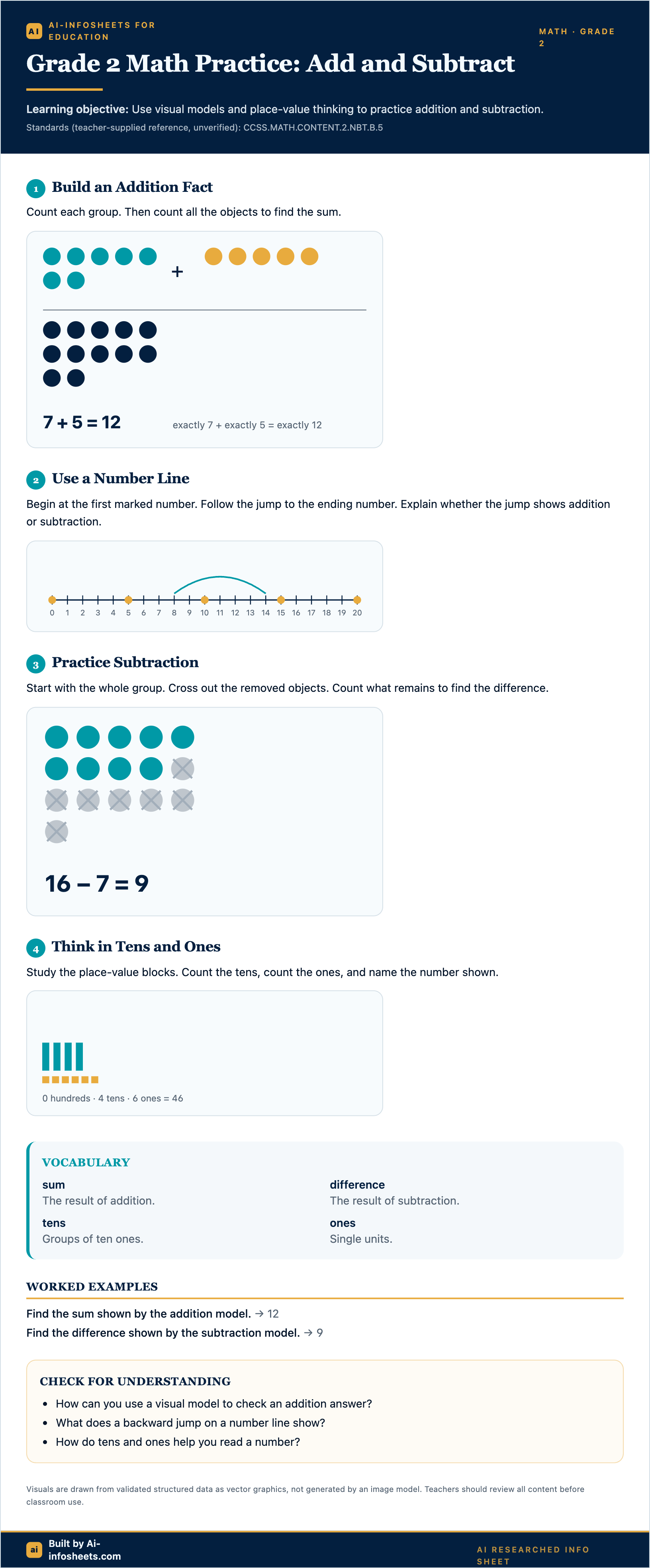
Count each group. Then count all the objects to find the sum.
Visual on the sheet: AdditionModel showing 7 + 5 = 12, drawn as an exact vector diagram.
Use a Number Line
Begin at the first marked number. Follow the jump to the ending number. Explain whether the jump shows addition or subtraction.
Visual on the sheet: NumberLine, drawn as an exact vector diagram.
Practice Subtraction
Start with the whole group. Cross out the removed objects. Count what remains to find the difference.
Visual on the sheet: SubtractionModel showing 16 − 7 = 9, drawn as an exact vector diagram.
Think in Tens and Ones
Study the place-value blocks. Count the tens, count the ones, and name the number shown.
Visual on the sheet: PlaceValueBlocks, drawn as an exact vector diagram.
Vocabulary
- sum — The result of addition.
- difference — The result of subtraction.
- tens — Groups of ten ones.
- ones — Single units.
Worked examples
- Find the sum shown by the addition model. → 12
- Find the difference shown by the subtraction model. → 9
Check for understanding
- How can you use a visual model to check an addition answer?
- What does a backward jump on a number line show?
- How do tens and ones help you read a number?
How to use this sheet
Print the sheet on US Letter paper or project it for whole-class instruction. Work the walkthrough sections in order, pause at each visual to have students describe what they see, then use the check-for-understanding prompts as an exit ticket. The vocabulary block doubles as a word wall, and the worked examples can be re-lettered for homework or centers.