
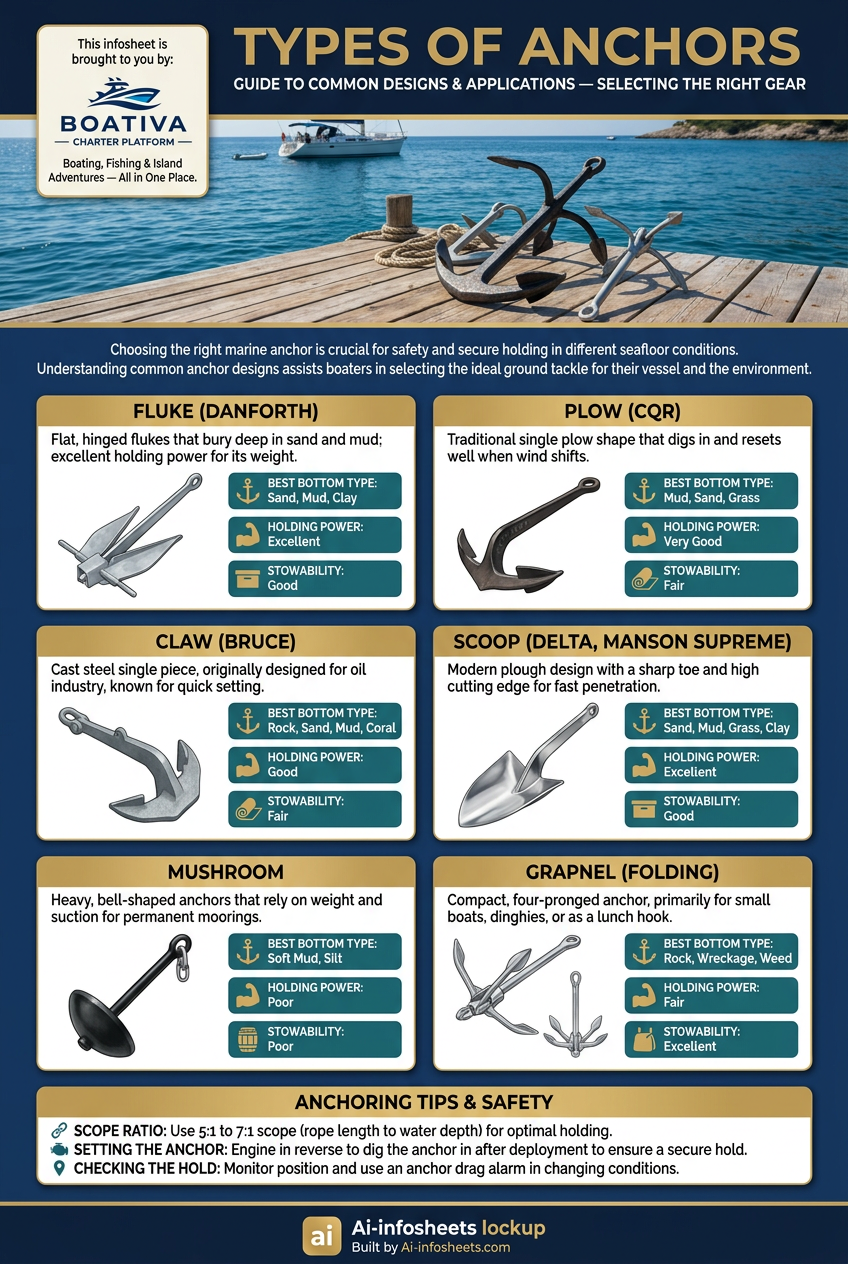
Anchoring a boat is a fundamental skill for any mariner, essential for temporary mooring, fishing, or emergency stops. The effectiveness of an anchor hinges significantly on its design, which dictates its ability to dig into and hold various seabed types. Selecting the appropriate anchor for your vessel and anticipated conditions is crucial for safety and peace of mind. This guide explores five primary types of anchors, detailing their characteristics, ideal applications, and how to make an informed choice for secure anchoring.
Understanding Anchor Holding Power and Factors
An anchor’s primary function is to hold a boat securely in place against winds, currents, and waves. This holding power isn’t solely determined by the anchor’s weight, but more by its design and its ability to penetrate and embed into the seabed. Factors such as the anchor's fluke area, shank length, and material all contribute to its effectiveness. The rode (the line or chain connecting the anchor to the boat) also plays a critical role, with a proper scope (ratio of rode length to water depth) being essential for the anchor to set correctly and maximize its holding potential. For typical monohull recreational boats, an anchor rode scope of 7:1 is commonly recommended in calm conditions, increasing in rougher seas to 10:1 or more for optimal holding ([source 1](#source1)).
Fluke Anchor (Danforth Style)
The fluke anchor, often referred to as a Danforth anchor, is characterized by its large, flat, pivoting flukes designed to dig deep into soft bottoms like sand and mud. Its lightweight yet high holding-power-to-weight ratio makes it very popular for smaller boats and as a secondary or stern anchor for larger vessels. When deployed, the flukes pivot to create a wide surface area that buries itself, providing excellent resistance. However, it may struggle to set in hard or rocky seabeds, where its flukes cannot penetrate.
Plow Anchor (CQR and Delta Styles)
Plow anchors, including designs like the CQR (Coastal Quick Release) and Delta, are known for their ability to set quickly and consistently in a wide variety of seabed types, from mud and sand to rock and grass. Their distinctive plow-like shape is designed to dig into the bottom and maintain a secure hold even when the boat swings with changes in wind or current. This makes them a favored choice for many cruising boaters. The CQR anchor, one of the oldest plow designs, is recognized for its articulated shank, while the Delta, a popular fixed-shank plow, is praised for its reliability and excellent holding power ([source 2](#source2)).
Claw Anchor (Bruce Style)
The claw anchor, popularized by the Bruce design, derived its unique shape from offshore oil rig anchors. It is renowned for its ability to set rapidly and reliably in almost any bottom, including mud, sand, rock, and even coral. Its single-piece construction and concave flukes allow it to reset quickly if the boat swings or if it breaks out. Many boaters appreciate its consistency and ease of use, making it a common choice for both primary and secondary anchoring.
Grapnel Anchor
Grapnel anchors feature multiple prongs or tines, designed primarily for small boats, kayaks, and dinghies, especially in rocky or coral environments. These prongs can hook onto rocks or other underwater structures. While excellent for temporary halts or retrieving items, their holding power on open, soft seabeds is limited. Some grapnel anchors are designed to fold up, making them very compact and easy to store, ideal for space-constrained vessels.
Mushroom Anchor
Mushroom anchors are typically used for permanent moorings or for very light, small craft in soft, muddy bottoms. Their unique inverted mushroom shape creates a suction effect in the mud as they settle, providing substantial holding power over time. They are not effective for transient anchoring from a boat, as they require significant time to properly embed and achieve their full holding potential. For example, a permanent mooring for a 20-foot boat might require a mushroom anchor weighing at least 200 pounds ([source 3](#source3)) to hold securely.
Choosing the right anchor is a critical decision that impacts your safety on the water. By understanding the strengths and weaknesses of each anchor type and matching it to your vessel, the conditions, and the seabed, you can ensure a secure and worry-free anchoring experience. Always consult your boat's manufacturer recommendations and local marine guidelines for specific anchoring practices.