
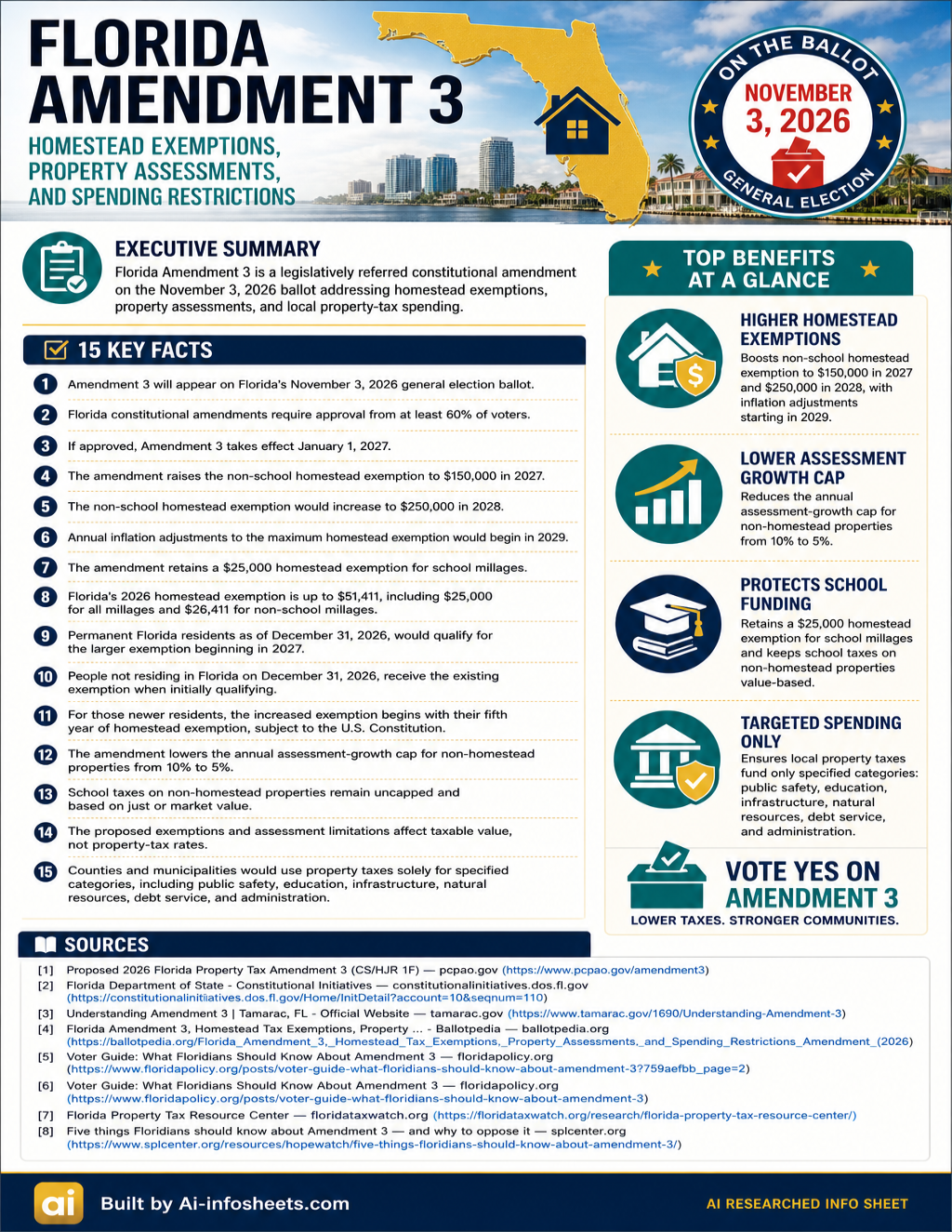


Florida Amendment 3, slated for the November 3, 2026 general election ballot, is a pivotal legislative initiative designed to reshape the state's property tax landscape. This proposed constitutional amendment addresses several key areas, including homestead exemptions, non-homestead property assessments, and restrictions on how local property tax revenues can be utilized. Sponsored by the Florida Legislature's House, the measure aims to provide homeowners with greater financial relief while implementing controls on tax growth for other property types and ensuring local tax revenues are directed toward essential community services. Understanding the specifics of Amendment 3 is crucial for all Floridians, as its approval will lead to significant adjustments starting in 2027.
Key Provisions of Florida Amendment 3
Florida Amendment 3 encompasses a range of important changes. Here are the core elements:
General Election Ballot and Approval
Florida Amendment 3 will officially appear on the November 3, 2026 general election ballot. As a legislatively referred constitutional amendment, it requires approval from at least 60% of voters to pass. If approved, the amendment is set to take effect on January 1, 2027.
Increased Non-School Homestead Exemption
The amendment proposes a significant increase to the non-school homestead exemption. Currently, the exemption stands at $25,000 for non-school taxes. This measure would raise it to $150,000 in 2027 and further increase it to $250,000 in 2028. Starting in 2029, this maximum non-school homestead exemption would also receive annual inflation adjustments.
Unchanged School Tax Homestead Exemption
It is important to note that the existing $25,000 homestead exemption applied to school taxes would remain unchanged under Amendment 3. The proposed increases apply only to the non-school portion of the homestead exemption, ensuring a specific fiscal balance related to education funding.
Reduced Non-Homestead Assessment Cap
For properties that are not primary homesteads—such as second homes, rentals, and commercial real estate—the amendment would reduce the annual assessment-increase cap from 10% to 5%. This change aims to control tax growth for these property types, offering predictability to owners of non-homestead properties.
Uncapped School Taxes for Non-Homestead Properties
While the general assessment cap for non-homestead properties would decrease, school taxes on these properties would remain uncapped. These taxes would continue to be based on the just or market value of the property, maintaining funding streams for public education.
Homestead Exemptions for New Residents
Special provisions are outlined for new Florida residents. People who were not Florida residents on December 31, 2026, would initially receive the existing homestead exemption. For these new residents, the increased exemption would begin with their fifth year of homestead exemption, ensuring a gradual transition and preventing immediate large-scale tax shifts.
Local Government Flexibility for Homestead Exemptions
The amendment mandates that counties and municipalities would receive a uniform procedure allowing them to increase the homestead exemption up to the full assessed value. Furthermore, special districts could also increase the exemption up to full assessed value, subject to local referendum approval. This provides local governments with more control over property tax relief.
Restrictions on Property Tax Revenue Use
Under Amendment 3, counties and municipalities would face specific restrictions on how they use property-tax revenue. Permitted uses would explicitly include public safety, education, infrastructure, natural resources, bond debt service, employee retirement benefits, operations, and administration. These restrictions aim to ensure tax dollars are directed toward essential community priorities and foster greater accountability and transparency in local spending.
Florida Amendment 3 offers a comprehensive approach to property tax reform, aiming to protect homeowners, lower tax pressure, and strengthen communities. With its potential to significantly alter the financial landscape for residents and local governments alike, voters are encouraged to review the details carefully to make an informed decision on November 3, 2026.