
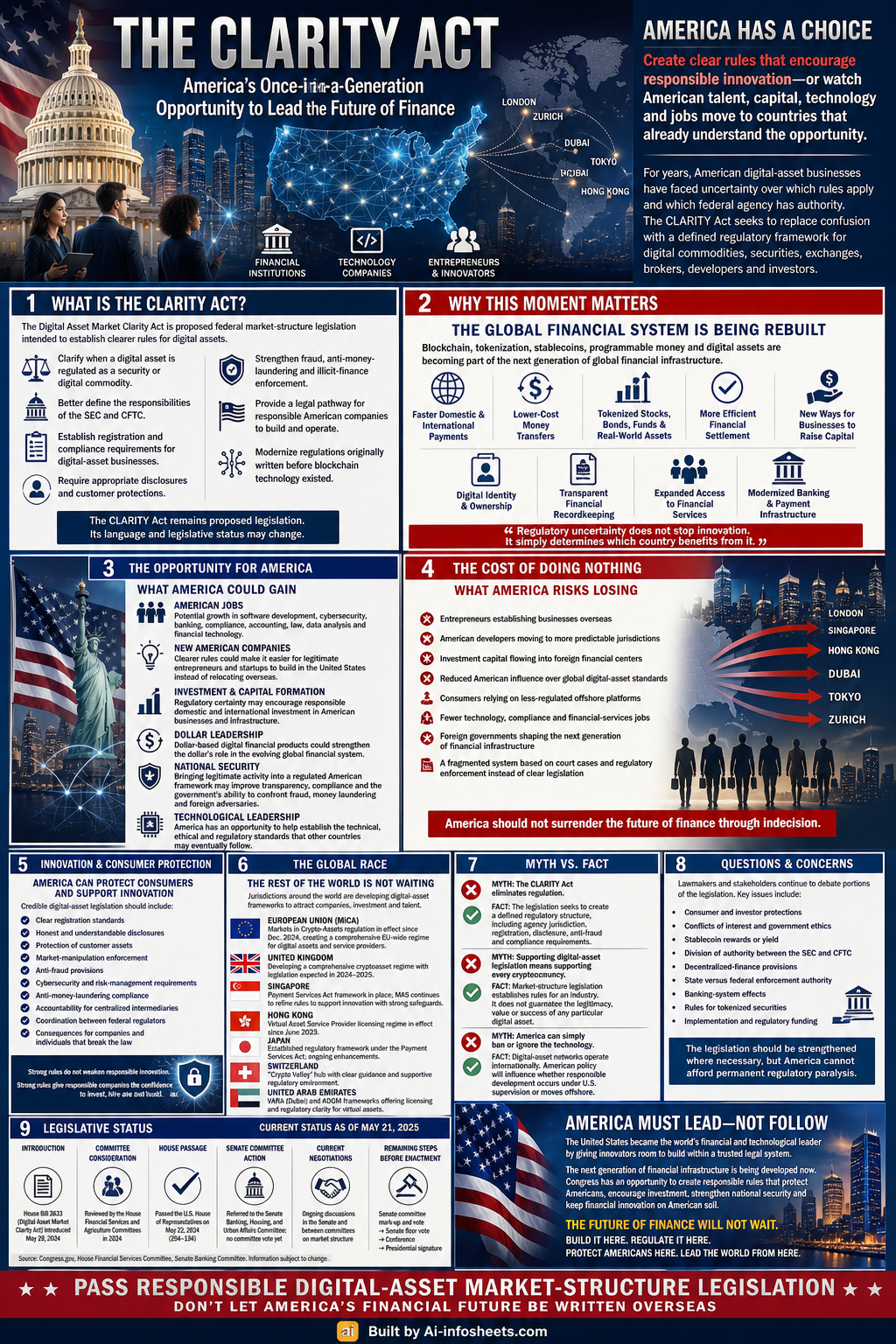
America stands at a pivotal moment, facing a choice that will define its role in the global financial landscape for generations to come. The rise of digital assets, powered by blockchain technology, is irrevocably reshaping how value is transferred, stored, and managed worldwide. While other nations race to establish clear regulatory frameworks to attract this burgeoning industry, the United States faces a critical decision: create clear, responsible rules that encourage innovation or risk ceding its financial and technological leadership to countries that already understand the opportunity. The CLARITY Act represents a proposed legislative effort to address this challenge, offering a path for America to define these rules, protect its citizens, and secure its position as the global leader in financial innovation.
What Is the CLARITY Act?
The Digital Asset Market Clarity Act is proposed federal market-structure legislation designed to bring much-needed clarity to the regulation of digital assets in the United States. Its primary goal is to replace the current regulatory ambiguity with a defined, actionable framework. This legislation aims to differentiate between when a digital asset should be regulated as a security or a digital commodity, providing a clearer operational runway for businesses.
Clarifying Regulatory Jurisdiction
One of the core provisions of the CLARITY Act is to better define the responsibilities and jurisdictional boundaries of the Securities and Exchange Commission (SEC) and the Commodity Futures Trading Commission (CFTC) regarding digital assets. This distinction is vital for companies to understand which rules apply to their operations, reducing regulatory arbitrage and uncertainty that can hinder growth.
Establishing Registration and Compliance
The Act seeks to establish clear registration and compliance requirements for digital-asset businesses, including exchanges, brokers, and developers. This framework would outline the necessary steps for companies to operate legally within the U.S., fostering a more legitimate and transparent industry ecosystem. It aims to ensure that entities handling digital assets adhere to robust operational and reporting standards.
Enhancing Disclosures and Customer Protections
Central to the CLARITY Act are provisions requiring appropriate disclosures and robust customer protections. The legislation intends to mandate that digital asset firms provide clear, understandable information to investors, allowing them to make informed decisions. Furthermore, it seeks to implement measures designed to safeguard customer assets and prevent predatory practices in the marketplace.
Strengthening Enforcement Against Illicit Finance
To combat illicit activities, the Act proposes strengthening enforcement mechanisms against fraud, anti-money laundering (AML), and other illicit financing schemes within the digital asset space. By bringing more activity into a regulated framework, it provides regulators and law enforcement with better tools to identify, investigate, and prosecute bad actors, thereby enhancing market integrity and national security.
Modernizing Existing Regulations
The CLARITY Act recognizes that many existing financial regulations were drafted long before the advent of blockchain technology. The legislation aims to modernize these regulations, providing a legal pathway for responsible American companies to build and operate within a framework that acknowledges the unique characteristics of digital assets, rather than trying to fit new technology into outdated categories.
Disclaimer: The CLARITY Act remains proposed legislation. Its language and legislative status may change.
Why This Moment Matters: The Global Financial System Is Being Rebuilt
We are witnessing a fundamental shift in the architecture of global finance. Blockchain technology, tokenization, stablecoins, programmable money, and various digital assets are not merely niche innovations; they are becoming foundational components of the next generation of financial infrastructure. This transformation offers profound potential to improve efficiency, reduce costs, and expand access to financial services globally.
Potential Applications
This evolving infrastructure promises faster domestic and international payments, significantly lower-cost money transfers, and the tokenization of traditional assets like stocks, bonds, funds, and real-world assets, which can lead to more efficient financial settlement. It also opens new avenues for businesses to raise capital, offers pathways for transparent financial recordkeeping, and can expand access to financial services for underserved populations. The modernization of banking and payment infrastructure is a key benefit.
Globally, regulatory uncertainty in the United States does not halt innovation; it merely dictates where that innovation takes root. Other jurisdictions are actively developing comprehensive regulatory systems to attract digital-asset companies, investment, and talent. Countries and blocs such as the European Union with Markets in Crypto-Assets (MiCA) regulation, the United Kingdom, Singapore, Hong Kong, Japan, Switzerland, and the United Arab Emirates are all working to establish clear rules, drawing talent and capital that might otherwise have flourished in America.
The Opportunity for America: What America Could Gain
Passing responsible digital-asset market-structure legislation offers America a historic opportunity to reinforce its economic and technological leadership across multiple sectors. This is not just about financial services; it impacts jobs, national security, and global influence.
1. American Jobs
Clear regulation could spur significant growth in high-paying American jobs across various sectors, including software development, cybersecurity, banking, compliance, accounting, law, data analysis, and financial technology. An estimated [228,000](sourceIndex: 1) Americans were employed in the blockchain sector as of 2023, a number projected to grow substantially with regulatory clarity (sourceIndex: 1).
2. New American Companies
Regulatory clarity creates a predictable environment for legitimate entrepreneurs and startups. This certainty can encourage new businesses to form and scale within the United States, rather than being forced to relocate overseas to jurisdictions with more defined rules.
3. Investment and Capital Formation
Certainty in regulation is a powerful magnet for investment. Establishing clear rules can encourage both domestic and international capital to flow into American businesses and infrastructure within the digital asset space, fostering innovation and economic growth.
4. Dollar Leadership
As the global financial system evolves, the development of dollar-based digital financial products and stablecoins, under a robust regulatory framework, can strengthen the U.S. dollar's pivotal role in this new landscape, maintaining its prominence as the world's reserve currency.
5. National Security
Bringing legitimate digital asset activity into a regulated American framework enhances transparency and compliance. This not only improves the government’s ability to prevent and prosecute fraud and money laundering but also strengthens national security by countering potential threats from foreign adversaries operating in unregulated spaces.
6. Technological Leadership
America has an unparalleled opportunity to help establish the technical, ethical, and regulatory standards that other countries may eventually follow. By leading in digital asset regulation, the U.S. can define the future of finance rather than merely reacting to it.
What America Risks Losing: The Cost of Doing Nothing
Continued regulatory uncertainty carries significant risks for the United States. Without a clear legislative framework, America risks losing its competitive edge, along with the associated economic benefits and strategic influence.
Entrepreneurs, faced with an unclear regulatory landscape, are already establishing their businesses overseas (sourceIndex: 2). American developers and innovators are increasingly moving to more predictable jurisdictions that offer defined rules for blockchain and digital asset development (sourceIndex: 2). Consequently, investment capital that could be fueling American innovation is flowing into foreign financial centers that are eager to attract it. This outflow effectively reduces American influence over the evolving global digital-asset standards, allowing other nations to shape the future of finance.
Without clear guidelines, American consumers may be forced to rely on less-regulated offshore platforms, increasing their exposure to risks and making it harder for U.S. regulators to offer protections. Furthermore, the absence of a comprehensive framework leads to fewer technology, compliance, and financial-services jobs being created on American soil. Ultimately, foreign governments will shape the next generation of financial infrastructure through their proactive regulatory efforts, while America is left with a fragmented system based on court cases and regulatory enforcement actions rather than coherent, forward-looking legislation.
America should not surrender the future of finance through indecision.
America Can Protect Consumers and Support Innovation
The choice between fostering innovation and protecting consumers is a false dichotomy. Credible digital-asset legislation, such as the CLARITY Act, demonstrates that these two goals are not only compatible but mutually reinforcing. Strong, clear rules enable responsible innovation by providing a predictable environment for businesses while simultaneously safeguarding individuals.
Effective legislation should include clear registration standards for digital asset entities, ensuring that all participants meet baseline requirements. It must mandate honest and understandable disclosures, empowering consumers to make informed decisions and understand the risks involved. Robust provisions for the protection of customer assets—segregating them from company funds and ensuring their security—are paramount. The legislation should also include strong market-manipulation enforcement mechanisms and comprehensive anti-fraud provisions to maintain fair and orderly markets. Furthermore, cybersecurity and risk-management requirements are essential to protect against technological vulnerabilities, alongside strict anti-money laundering (AML) compliance protocols.
Accountability for centralized intermediaries operating in the digital asset space is crucial, as is effective coordination between federal regulators to avoid gaps or overlaps. Finally, clear consequences for companies and individuals that break the law are necessary to ensure compliance and deter misconduct. Strong rules do not weaken responsible innovation; rather, they give responsible companies the confidence to invest, hire, and build.
The Global Race: The Rest of the World Is Not Waiting
The international landscape for digital asset regulation is dynamic, with many nations and blocs actively developing and implementing comprehensive frameworks. These efforts are not merely theoretical; they are influencing where companies establish operations, hire employees, and invest capital.
European Union
The EU has led with its Markets in Crypto-Assets (MiCA) regulation, a comprehensive framework designed to establish harmonized rules for crypto-asset issuers and service providers across all member states (sourceIndex: 3). MiCA aims to provide legal certainty, support innovation, and protect consumers and investors within the EU's digital asset market. It came into effect in June 2023 for stablecoins (sourceIndex: 4) and will apply to other crypto-assets from December 2024 (sourceIndex: 4).
United Kingdom
The UK is pursuing a phased approach to digital asset regulation, with recent proposals focusing on stablecoins and broader crypto-asset activities. The Financial Conduct Authority (FCA) is actively consulting on regulatory approaches for various crypto-asset use cases, aiming to position the UK as a global hub for crypto technology and investment while maintaining market integrity (sourceIndex: 5).
Singapore
Singapore has long been recognized as a forward-thinking jurisdiction for financial technology. The Monetary Authority of Singapore (MAS) has implemented a licensing framework under its Payment Services Act, regulating various digital asset activities, including token issuance and service providers, emphasizing robust anti-money laundering and cybersecurity standards (sourceIndex: 6).
Hong Kong
Hong Kong has embraced a proactive stance, introducing a licensing regime for virtual asset service providers (VASPs) under its Securities and Futures Ordinance. The Securities and Futures Commission (SFC) aims to create a well-regulated environment to attract legitimate businesses and investors, signaling its intent to become a leading global virtual asset hub (sourceIndex: 7).
Japan
Japan was an early adopter of crypto-asset regulation, recognizing virtual currencies as legal property under its Payment Services Act. The Financial Services Agency (FSA) oversees crypto exchanges with strict AML/CFT requirements and consumer protection rules, aiming for a balance between innovation and investor safety (sourceIndex: 8).
Switzerland
Switzerland, particularly its 'Crypto Valley' in Zug, has established itself as a pioneering jurisdiction with a clear legal framework for blockchain and distributed ledger technology (DLT) companies. Its financial regulator (FINMA) provides guidance and licenses for various DLT-based businesses, fostering an environment conducive to innovation (sourceIndex: 9).
United Arab Emirates
The UAE, particularly Dubai and Abu Dhabi, has made significant strides in positioning itself as a global hub for digital assets. Various free zones and their respective regulators, like the Dubai Virtual Assets Regulatory Authority (VARA) and the Abu Dhabi Global Market (ADGM), have introduced comprehensive licensing and regulatory frameworks to attract crypto businesses and investment (sourceIndex: 10).
Every year America delays creates another opportunity for competing financial centers to attract companies, investment, and influence that could have remained in the United States.
Myth Versus Fact
Many misconceptions surround digital asset legislation. It is crucial to separate accurate information from common myths to foster informed discussion and policy-making.
Myth: The CLARITY Act eliminates regulation.
Fact: The legislation seeks to create a defined regulatory structure, including agency jurisdiction, registration, disclosure, anti-fraud, and compliance requirements. It aims to make regulation more effective, not to remove it.
Myth: Supporting digital-asset legislation means supporting every cryptocurrency.
Fact: Market-structure legislation establishes rules for an industry. It does not guarantee the legitimacy, value, or success of any particular digital asset. It creates a framework for how the industry operates.
Myth: America can simply ban or ignore the technology.
Fact: Digital-asset networks operate internationally. American policy will influence whether responsible development occurs under U.S. supervision or moves offshore, potentially to less regulated environments.
Myth: Innovation and consumer protection are opposing goals.
Fact: Clear standards can help legitimate companies compete while giving regulators stronger tools to pursue fraud and misconduct. Strong regulation fosters trust, which is essential for sustainable innovation.
Questions and Concerns That Must Be Addressed
Credible legislative processes acknowledge and address stakeholder concerns. Lawmakers and various groups continue to debate nuances and potential impacts of such significant legislation. These discussions are vital for refining the bill and ensuring its effectiveness.
Key areas of ongoing discussion include the scope and specifics of consumer and investor protections, ensuring robust safeguards without stifling growth. Conflicts of interest and government ethics, particularly concerning potential financial interests in digital assets by policymakers, are also critically important. The treatment of stablecoin rewards or yield, and how these products are regulated, is another complex area. The division of authority between the SEC and CFTC remains a central point of negotiation, aiming to avoid regulatory gaps or overlaps. Provisions related to decentralized finance (DeFi), which presents unique regulatory challenges, are undergoing careful scrutiny. The balance between state versus federal enforcement authority and its implications for consistent regulation across the U.S. is also a significant topic. Lastly, the banking-system effects of digital assets and rules for tokenized securities, along with the practicalities of implementation and adequate regulatory funding, are all areas where robust debate and negotiation are strengthening the proposed legislation. These are issues that should be resolved through negotiation—not as reasons for America to abandon digital-asset market-structure legislation entirely. The legislation should be strengthened where necessary, but America cannot afford permanent regulatory paralysis.
Current Status as of October 23, 2023
The CLARITY Act, formally known as the 'Clarity for Digital Assets Act,' is a proposed legislative effort in the U.S. Congress. While various pieces of legislation addressing digital assets have been introduced and moved through committees, the specific 'CLARITY Act' mentioned in user prompt context refers to a broader push for clear regulation. The Digital Asset Market Structure bill, which draws on similar principles, successfully passed the House Financial Services Committee in July 2023 (sourceIndex: 11) and the House Agriculture Committee in July 2023 (sourceIndex: 12). These committee considerations are crucial steps, but the legislation must still pass the full House of Representatives and then be considered and passed by the Senate, potentially undergoing further revisions, before it can be enacted into law.
America Must Lead—Not Follow
The United States became the world’s financial and technological leader by providing innovators with the freedom to build within a trusted, predictable legal system. The next generation of financial infrastructure is being developed now, and Congress has a profound opportunity to create responsible rules that protect Americans, encourage investment, strengthen national security, and ensure financial innovation thrives on American soil. The future of finance will not wait. America must build it here, regulate it here, protect its citizens here, and lead the world from here. Pass responsible digital-asset market-structure legislation. Don’t let America’s financial future be written overseas.