
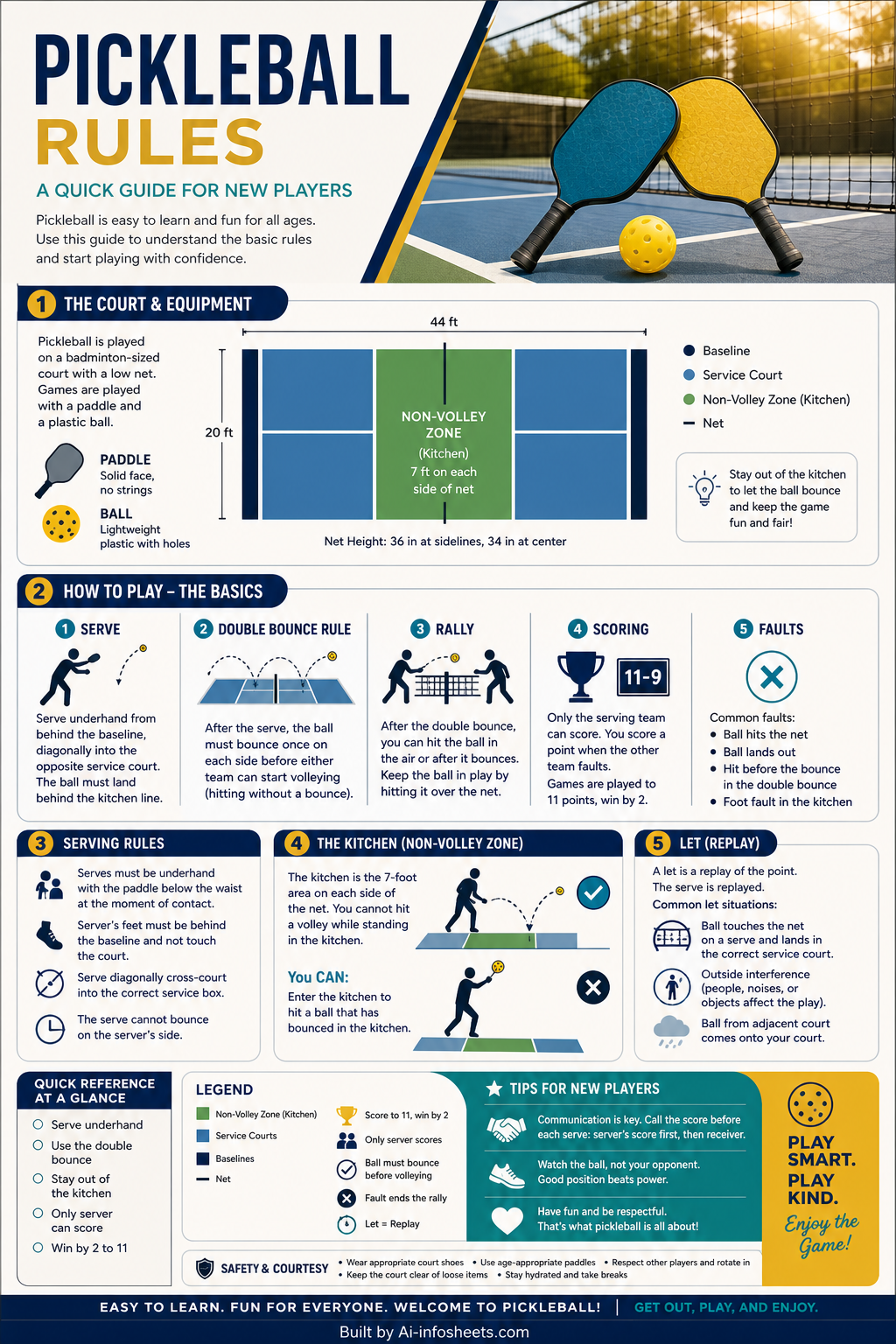


Pickleball is one of the fastest-growing sports in the world, combining elements of tennis, badminton, and table tennis. Its straightforward rules and accessibility make it incredibly popular for players of all ages and skill levels. Whether you're stepping onto the court for the first time or need a quick refresher, understanding the fundamental rules is key to enjoying the game and playing safely. This guide will walk you through the essential regulations, from serving and scoring to navigating the unique 'kitchen' area, ensuring you're well-equipped to join the fun.
The Court and Equipment
Pickleball is played on a badminton-sized court, measuring 20 feet (6.1 meters) wide by 44 feet (13.4 meters) long, for both singles and doubles play. A net divides the court, which is set at 36 inches (91.44 cm) high at the sidelines and 34 inches (86.36 cm) high in the center. The court also features a non-volley zone, often called 'the kitchen,' extending 7 feet (2.13 meters) from the net on each side. Players use solid paddles and a perforated plastic ball, similar to a Wiffle ball, which travels at about one-third the speed of a tennis ball.
Scoring
Pickleball is usually played to 11 points, though some games go to 15 or 21. A team must win by at least 2 points. Only the serving team can score a point. When the serving team wins a rally, they score a point. If the receiving team wins the rally, no point is scored, and the serve passes to the other team (or to the second server of the current team in doubles). Scores are called with three numbers in doubles: the serving team's score, the receiving team's score, and then the server number (1 or 2). For example, “3-2-1” means the serving team has 3 points, the receiving team has 2, and it’s the first server.
Serving Rules
Serving in pickleball has specific requirements. The serve must be made underhand, with the paddle head below the wrist at the moment of contact. Contact with the ball must be made below the waist. The server must hit the ball into the opponent's service court, which is the rectangle diagonally opposite them, clearing the kitchen line. Only one serve attempt is allowed, except if the ball touches the net and still lands in the correct service court (a “let” serve), in which case it is replayed.
The Double Bounce Rule
Often called the 'two-bounce rule,' this dictates that the ball must bounce once on each side of the net after the serve before players can volley (hit the ball in the air without it bouncing). This means the serving team must let the return of serve bounce, and the receiving team must let the serve bounce. After these two bounces, players may volley the ball or hit it after a bounce.
The No-Volley Zone (The Kitchen)
Arguably the most unique rule in pickleball is the No-Volley Zone, or 'the kitchen.' Players are not allowed to volley the ball while standing in the kitchen, or if any part of their body or clothing is touching the kitchen line or the kitchen itself. Players can enter the kitchen to hit a ball that has bounced, and they can remain there for as long as needed to return the ball, but they must exit the kitchen before making a volley. This rule prevents players from spiking the ball aggressively from close to the net, promoting softer play and strategic dinks.
Common Faults
Understanding faults is crucial as they result in losing the serve or a point for the serving team. Common faults include hitting the ball out of bounds, hitting the net and failing to clear it, volleying the ball while standing in the kitchen, or failing to adhere to the double bounce rule. Additionally, serving faults like hitting the ball above the waist or overhand, or hitting the ball outside the designated service area, are also penalized.
Mastering these basic rules will significantly enhance your pickleball experience, allowing you to confidently engage in rallies and understand the flow of the game. Always remember to prioritize fair play and good sportsmanship, as these are core tenets of the pickleball community. Grab your paddle, find a court, and enjoy the game!