
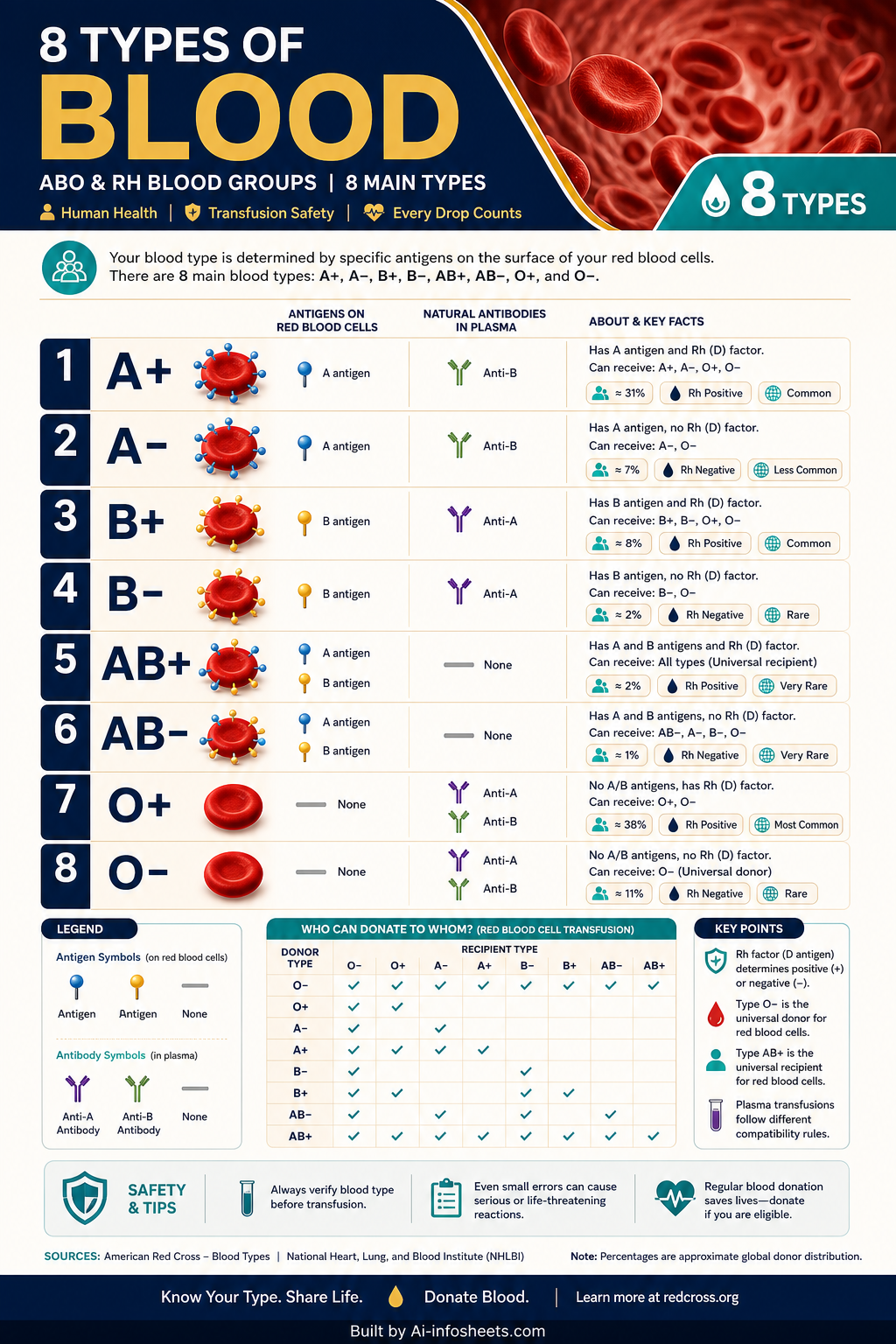
Human blood is a complex biological fluid essential for life, performing functions like transporting oxygen, nutrients, hormones, and waste products throughout the body. While seemingly similar, not all blood is identical. The most critical distinction lies in its type, determined by the presence or absence of specific antigens on the surface of red blood cells. Understanding these blood types is paramount, especially in medical contexts such as blood transfusions, where incompatible blood can lead to severe, even fatal, reactions. The ABO blood group system, discovered by Karl Landsteiner in 1901, categorizes human blood into four primary types: A, B, AB, and O, each with unique characteristics influencing their compatibility.
The ABO Blood Group System
The ABO blood group system is the most important classification for human blood transfusions. It's based on the presence or absence of two antigens, A and B, on the surface of red blood cells, and the presence or absence of corresponding antibodies in the plasma. Antibodies are proteins in the blood plasma that recognize and destroy foreign substances. If a person receives blood containing antigens that their own antibodies recognize as foreign, a severe immune response can occur, causing red blood cells to clump together (agglutination), which can be life-threatening.
Type A Blood
Individuals with Type A blood have A antigens on the surface of their red blood cells and B antibodies in their plasma. These B antibodies will attack any blood cells that have B antigens. Therefore, Type A individuals can receive blood from Type A and Type O donors, but cannot receive Type B or Type AB blood as it contains B antigens. Approximately between 38% and 40% of the population in the United States has Type A blood, making it one of the more common types.
Type B Blood
People with Type B blood possess B antigens on their red blood cells and A antibodies in their plasma. Their A antibodies will react against A antigens. This means individuals with Type B blood can safely receive blood from Type B and Type O donors. They cannot, however, receive Type A or Type AB blood due to the presence of A antigens. Globally, Type B blood is found in approximately between 10% and 11% of the population, with variations across different ethnic groups.
Type AB Blood
Type AB blood is characterized by having both A and B antigens on the red blood cell surface, but no A or B antibodies in the plasma. The absence of both types of antibodies makes Type AB individuals universal recipients, meaning they can receive blood from Type A, Type B, Type AB, and Type O donors without an adverse reaction caused by ABO incompatibility. This makes Type AB blood relatively rare, representing only between 4% and 5% of the population in the United States. Its unique composition allows for broad compatibility in transfusions.
Type O Blood
Individuals with Type O blood do not have A or B antigens on their red blood cells, but they have both A and B antibodies in their plasma. This makes Type O individuals universal donors because their red blood cells won't trigger an immune response from A or B antibodies in a recipient's plasma. However, they can only receive blood from other Type O donors due to the presence of both A and B antibodies in their own plasma. Type O blood is the most common blood type, found in between 42% and 45% of the U.S. population, offering a critical resource for blood banks.
Knowing your blood type is a simple yet crucial piece of health information that can have life-saving implications. Whether for emergency transfusions, organ transplants, or prenatal care, understanding the ABO system and the Rh factor (another important antigen) is fundamental. Consult your healthcare provider to learn your blood type and consider becoming a blood donor to help save lives.