
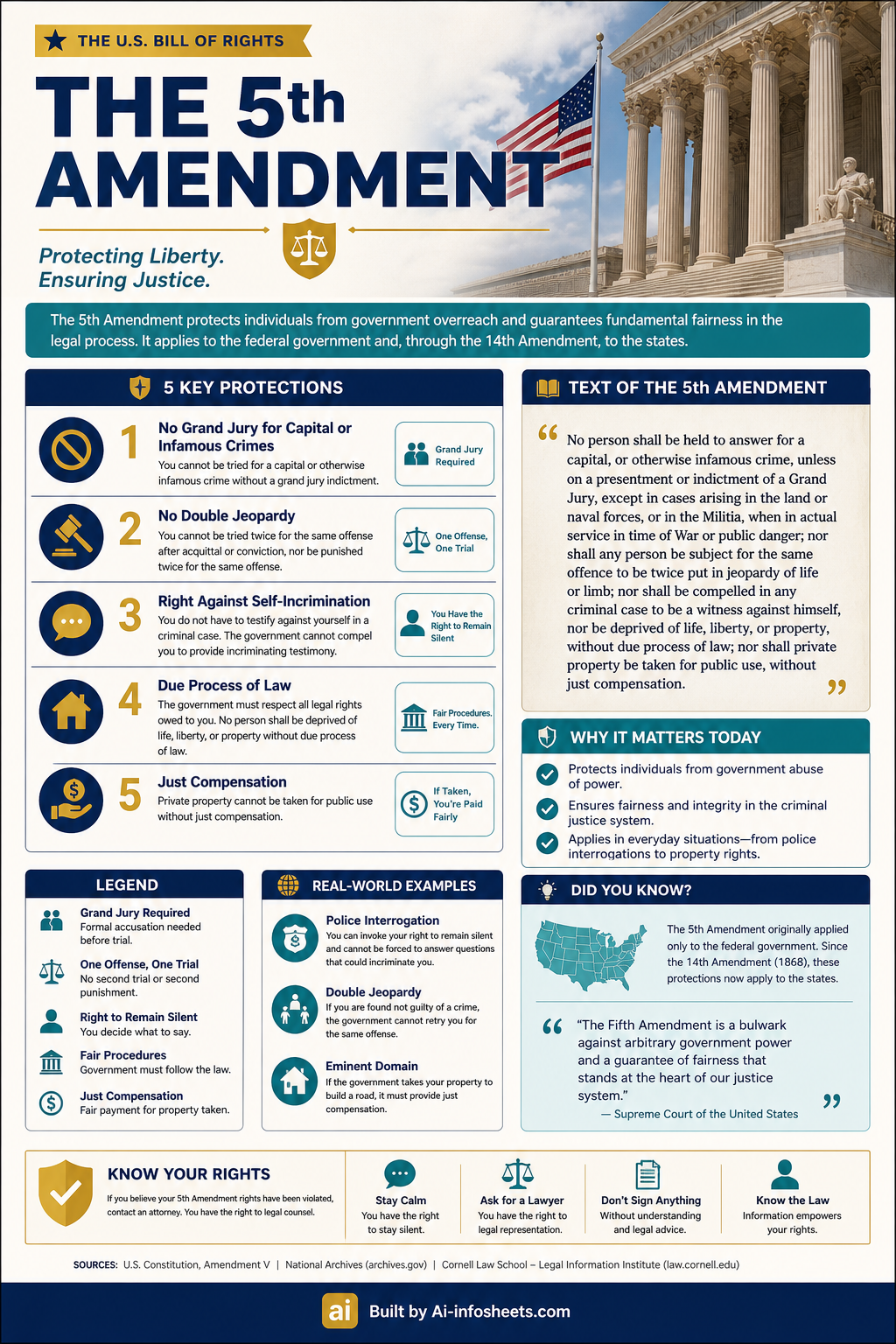
The Fifth Amendment to the United States Constitution is a pivotal component of the nation's Bill of Rights, meticulously crafted to protect individual liberties against potential abuses of governmental authority. Ratified on December 15, 1791, as part of the Bill of Rights, it outlines a series of procedural safeguards designed to ensure fairness and justice, particularly within the legal system. Its provisions are foundational to understanding the rights of the accused and the limits of state power, covering everything from the formal accusation of a crime to the protection of private property rights. This amendment has profoundly shaped American jurisprudence and remains a critical shield for individuals in legal encounters.
Key Protections of the Fifth Amendment
Grand Jury Right
The Fifth Amendment mandates that "No person shall be held to answer for a capital, or otherwise infamous crime, unless on a presentment or indictment of a Grand Jury." This clause ensures that before a person can be tried for a serious federal felony, a grand jury must first determine if there is sufficient evidence to bring charges. The grand jury acts as a buffer between the accuser (the government) and the accused, preventing arbitrary or politically motivated prosecutions by requiring an independent body to review the evidence. This protection applies specifically to federal criminal cases, though states have their own varying procedures for determining probable cause.
Protection Against Double Jeopardy
"No person shall be subject for the same offence to be twice put in jeopardy of life or limb." This clause is known as the Double Jeopardy Clause, preventing an individual from being prosecuted or punished multiple times for the same offense after either an acquittal or conviction. Its purpose is to protect individuals from harassment by the state, financial burdens of repeated trials, and the psychological strain of continued uncertainty. There are certain exceptions, such as when a trial ends in a mistrial, or if different sovereigns (e.g., state and federal governments) prosecute the same act as distinct offenses.
Right Against Self-Incrimination
Perhaps the most famous clause, the right against self-incrimination, states that "No person...shall be compelled in any criminal case to be a witness against himself." This is often referred to as "pleading the Fifth." It protects individuals from being forced to testify or provide evidence that could incriminate them in a criminal proceeding. This right extends beyond the courtroom, famously encapsulated by the Miranda warnings, which inform suspects of their right to remain silent during police interrogations. The Supreme Court case Miranda v. Arizona (1966) solidified the requirement for law enforcement to inform suspects of this right prior to custodial interrogation.
Due Process Clause
"nor be deprived of life, liberty, or property, without due process of law." The Due Process Clause is a broad and fundamental protection, ensuring governmental actions respect legal rights and procedures. It has two main aspects: procedural due process and substantive due process. Procedural due process requires that government decision-making processes for depriving an individual of life, liberty, or property must be fair, requiring notice and an opportunity to be heard. Substantive due process protects certain fundamental rights from governmental interference, regardless of the procedures used, even if those rights are not explicitly mentioned elsewhere in the Constitution.
Takings Clause (Eminent Domain)
Finally, the Fifth Amendment concludes with the Takings Clause: "nor shall private property be taken for public use, without just compensation." This clause establishes the principle of eminent domain, allowing the government to seize private property for public use (such as for roads, schools, or public utilities). However, it strictly requires that the property owner receive a fair market value for their property—"just compensation." This prevents arbitrary seizures and ensures that individuals are not unfairly burdened by public projects by shifting the cost of public services to the public as a whole.
Understanding the nuanced protections afforded by the Fifth Amendment is crucial for every citizen. These constitutional safeguards are not merely legal technicalities; they represent fundamental principles of fairness, justice, and the limitation of government power, ensuring that individual rights are upheld. Recognizing these rights empowers individuals and reinforces the checks and balances essential to a democratic society. Make sure you are aware of your rights, especially when interacting with the legal system, as they are designed to protect your liberty and ensure fair treatment under the law.