
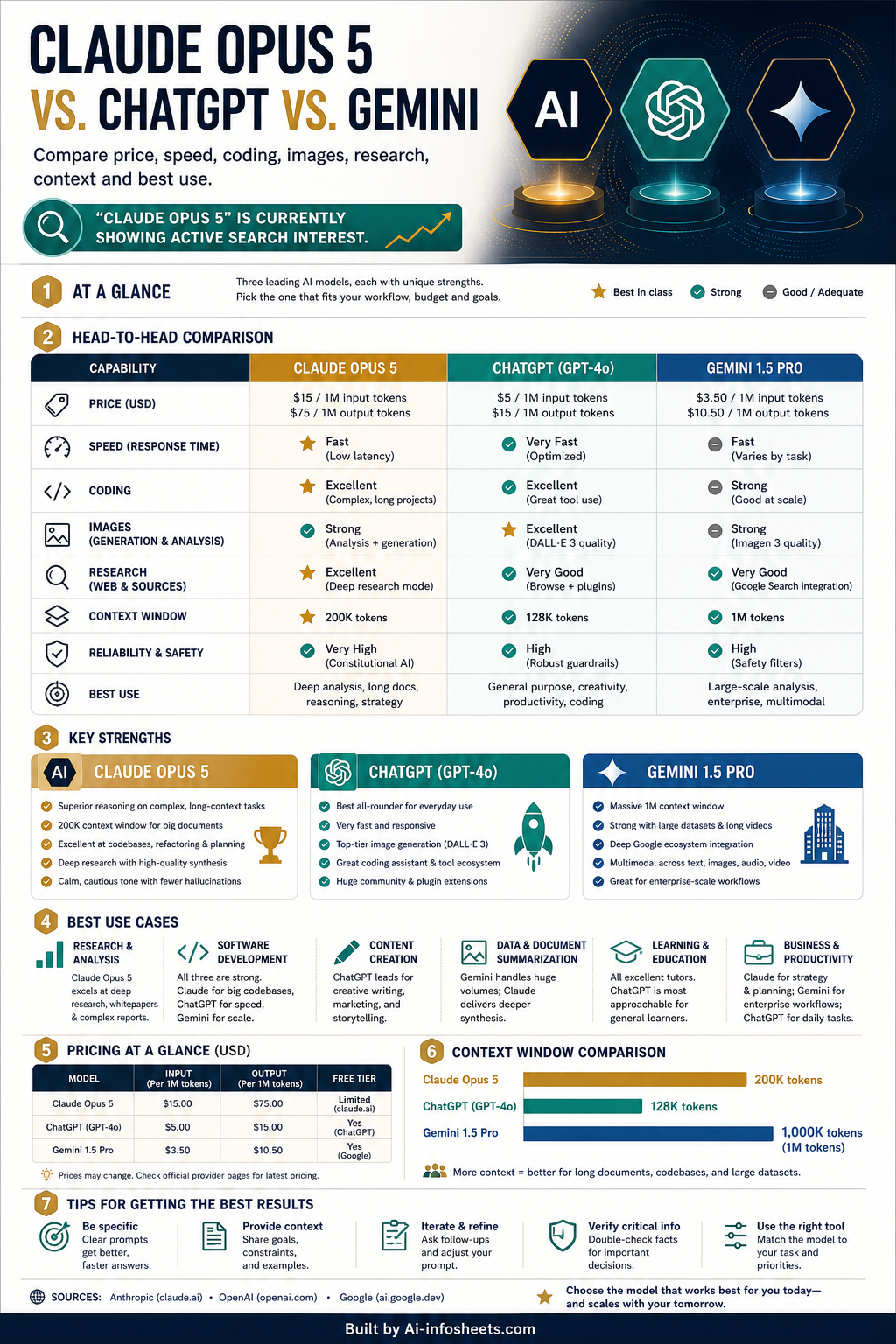


The artificial intelligence landscape is in constant flux, with new and improved models emerging regularly. Among the frontrunners, Claude Opus, ChatGPT, and Google Gemini stand out for their advanced capabilities and widespread adoption. Understanding the nuanced differences between these powerful large language models (LLMs) is crucial for selecting the right tool for specific applications, whether for creative content generation, complex problem-solving, or efficient data analysis. This comparative analysis delves into their core features, performance metrics, and ideal use cases.
Understanding the Core Models
Each of these AI models represents a significant leap in natural language processing and understanding. Developed by different companies – Anthropic for Claude, OpenAI for ChatGPT, and Google for Gemini – they bring distinct architectural designs and training methodologies to the table.
Claude Opus
Claude Opus is Anthropic's flagship model, known for its strong reasoning abilities, extensive context window, and robust performance in complex, multi-step tasks. It is designed to be highly reliable and steerable, focusing on safety and interpretability. Claude Opus excels in tasks requiring deep comprehension and logical inference, making it a powerful tool for sophisticated analysis and strategic planning.
ChatGPT (GPT-4 / GPT-4o)
ChatGPT, especially in its GPT-4 and GPT-4o iterations by OpenAI, is celebrated for its versatility and general-purpose capabilities. It integrates seamlessly into various applications and offers strong performance across a broad spectrum of tasks, from creative writing to coding and factual query answering. GPT-4o, in particular, has enhanced multimodal capabilities, improving its ability to process and generate content across text, audio, and visual inputs.
Google Gemini (Advanced/Ultra)
Google Gemini, available in versions like Gemini Advanced and Gemini Ultra, is Google's most capable and multimodal AI model. It is built from the ground up to understand and operate across different types of information, including text, images, audio, and video. Gemini is particularly potent for tasks that require real-world understanding and integration of diverse data formats, leveraging Google's vast information ecosystem.
Performance and Feature Comparison
When evaluating these top-tier AI models, several key metrics come into play, including pricing, processing speed, coding proficiency, image generation capabilities, research aptitude, and the size of their context windows.
Pricing Models
Pricing for these advanced AI models typically follows a token-based structure, where cost is determined by the amount of input and output processed. Claude Opus, for example, is generally positioned at a higher price point due to its advanced reasoning and larger context window, with input tokens costing approximately $0.015 per 1,000 tokens and output tokens around $0.075 per 1,000 tokens for Opus 3.5. ChatGPT, through OpenAI's API, offers GPT-4 at varying rates; for instance, GPT-4 Turbo often costs about $0.01 per 1,000 input tokens and $0.03 per 1,000 output tokens. Newer models like GPT-4o offer more competitive pricing at $5.00 per million input tokens and $15.00 per million output tokens. Gemini Advanced typically comes with a subscription fee (e.g., $19.99 per month for the Google One AI Premium Plan) which includes access to the most capable Gemini models and other Google benefits. It is important to note that specific pricing can vary based on usage volume and API versions.
Processing Speed
Speed is a critical factor for real-time applications and high-volume tasks. While precise, universally comparable benchmarks are challenging due to varying infrastructure and task complexity, general observations can be made. Claude Opus, despite its advanced reasoning, can sometimes exhibit a slightly slower response time compared to its counterparts when handling extremely long or complex prompts, prioritizing accuracy and depth. ChatGPT’s GPT-4 Turbo and GPT-4o generally offer commendable speeds, with GPT-4o specifically designed for enhanced responsiveness across modalities. Gemini is also optimized for speed, particularly within Google's cloud infrastructure, providing rapid responses, especially in multimodal scenarios. Google has stated that Gemini Ultra 1.0 can process information faster than human experts in certain benchmarks.
Coding Efficacy
All three models show significant capabilities in code generation, debugging, and understanding. Claude Opus demonstrates strong performance in producing well-reasoned and secure code, often excelling in complex programming challenges. ChatGPT (GPT-4/GPT-4o) is widely used by developers for various coding tasks, from generating snippets to refactoring entire functions, with a vast training dataset including extensive code. Gemini, leveraging Google's expertise in software development, is also highly proficient in coding, capable of generating code in multiple languages and assisting with intricate software engineering problems. Some reports suggest that Gemini 1.5 Pro can handle codebases up to 100,000 lines of code efficiently.
Image Generation
Image generation capabilities vary significantly. Claude Opus currently does not natively generate images; its strengths lie primarily in text-based reasoning and analysis. ChatGPT, through integration with DALL-E 3, offers robust and creative image generation directly within its interface, allowing users to create high-quality visuals from text prompts. Gemini, as a natively multimodal model, possesses strong image understanding and generation capabilities. This allows it to interpret visual input and generate original images or enhance existing ones, making it particularly powerful for tasks that bridge text and visual media. The ability to integrate other models like Imagen further strengthens Google’s multimodal offering in this space.
Research and Context Window
For complex research and analysis, a model's ability to handle extensive input (context window) is paramount. Claude Opus is renowned for its very large context window, often able to process hundreds of thousands of tokens (equivalent to hundreds of pages of text) in a single prompt. This allows it to maintain coherence and draw nuanced insights from vast amounts of information, making it ideal for deep document analysis and synthesis. ChatGPT's GPT-4 Turbo has an impressive context window of 128,000 tokens, enabling it to handle substantial documents and conversations. Gemini also boasts a significant context window, with Gemini 1.5 Pro offering a 1-million token context window, which is particularly useful for analyzing large codebases, long form literary works, or extensive data sets. This immense capacity allows for unparalleled continuity and detailed understanding across long-form content.
Best Use Cases
Each model shines in different scenarios, making them suited for specific applications:
- Claude Opus: Ideal for highly analytical tasks, legal document review, scientific research synthesis, strategic business planning, and applications requiring high levels of safety and interpretability. Its extensive context window makes it invaluable for processing and reasoning over large bodies of text.
- ChatGPT (GPT-4/GPT-4o): Best for general content creation (articles, marketing copy), customer support, educational assistance, programming tasks, and scenarios requiring versatile multimodal interaction (voice, text, image). Its broad utility makes it a default choice for many.
- Google Gemini (Advanced/Ultra): Excels in multimodal understanding, educational tools, creative brainstorming across different media, real-world data integration, and applications leveraging Google's ecosystem (e.g., Google Workspace integration, search functionalities). It is particularly strong for use cases that require processing and generating diverse data formats simultaneously.
In conclusion, the choice between Claude Opus, ChatGPT, and Gemini depends heavily on your specific needs and priorities. While Claude Opus leads in deep reasoning and context handling, ChatGPT offers unmatched versatility and strong multimodal support, and Gemini leverages its multimodal design and Google's data integration for comprehensive, real-world applications. By carefully considering their strengths and weaknesses, users can harness the full potential of these advanced AI models.
Ready to elevate your projects with AI? Explore the specific APIs and subscription plans offered by Anthropic, OpenAI, and Google to determine which model best aligns with your technical requirements and budget. Stay ahead in the rapidly evolving world of artificial intelligence by choosing the tool that empowers your unique goals.