
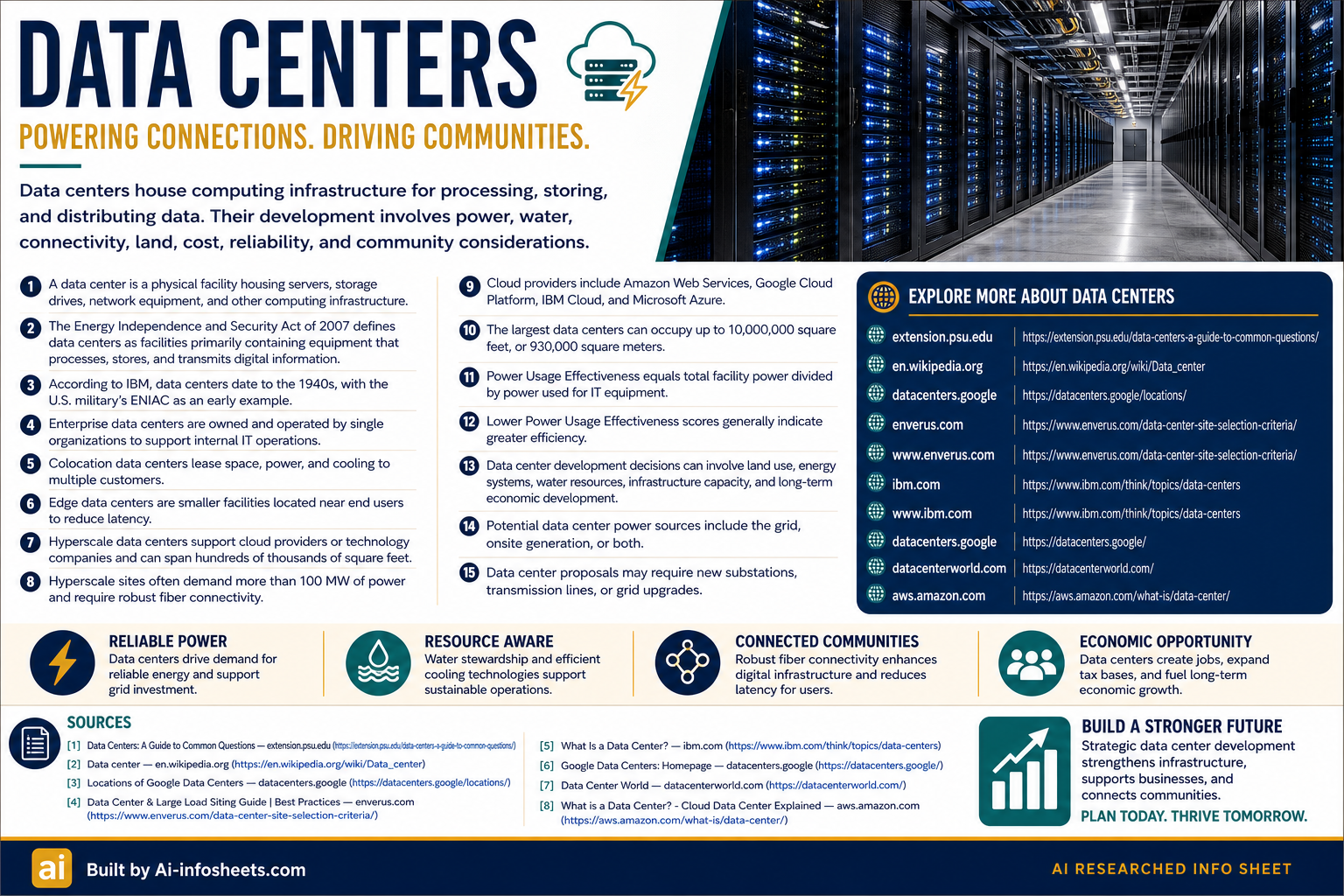


Data centers are the unseen powerhouses of the digital age, essential physical facilities that house the vast computing infrastructure necessary for processing, storing, managing, and distributing digital information. From everyday internet browsing to complex cloud applications, these facilities form the backbone of our interconnected world. Their development is a complex undertaking, requiring careful consideration of power availability, water resources for cooling, robust connectivity, suitable land, cost implications, reliability, and potential community impacts.
Understanding Data Centers
A data center fundamentally serves as a central repository for electronic information, housing computing infrastructure like servers, storage drives, networking hardware, and other related equipment. The Energy Independence and Security Act of 2007 formally defines data centers as facilities primarily containing equipment that processes, stores, and transmits digital information, underscoring their critical role in modern society.
Historically, data centers trace their origins back to the 1940s, with pioneers like the U.S. military's ENIAC serving as an early example of large-scale computing infrastructure. Today, these facilities can range from dedicated buildings to specific spaces within larger structures, all designed with environmental controls to ensure optimal operating conditions for sensitive electronic equipment.
Enterprise Data Centers
Enterprise data centers are owned and operated by a single organization, exclusively supporting its internal IT operations. These facilities are tailored to meet the specific needs and security requirements of the owning entity, providing dedicated resources for its business applications and data storage.
Cloud Data Centers
Cloud data centers provide computing resources, storage, and applications over the internet as a service. Major providers include Amazon Web Services (AWS), Google Cloud Platform, IBM Cloud, and Microsoft Azure. These services allow businesses and individuals to access scalable IT infrastructure without the need for on-premises hardware.
Colocation Data Centers
Colocation data centers offer a model where multiple customers can lease space, power, and cooling for their own IT equipment within a shared facility. This option provides businesses with enterprise-grade infrastructure and connectivity without the significant capital expenditure of building and maintaining their own data center.
Edge Data Centers
Edge data centers are smaller facilities strategically located closer to end-users and devices. Their primary purpose is to reduce latency, enabling faster processing of data for real-time services like streaming video, Internet of Things (IoT) applications, and online gaming. By bringing data processing closer to the source, edge computing enhances user experience and supports emerging technologies.
Hyperscale Data Centers
Hyperscale data centers are massive, highly scalable facilities that support cloud providers or large technology companies. These facilities can span hundreds of thousands of square feet and often require more than 100 megawatts (MW) of power, along with robust fiber connectivity to handle immense data volumes and traffic. The largest data centers can occupy up to 10,000,000 square feet, equivalent to 930,000 square meters.
Operational Considerations and Impact
The efficiency of a data center is often measured by its Power Usage Effectiveness (PUE), which equals the total facility power divided by the power used specifically for IT equipment. Lower PUE scores generally indicate greater energy efficiency, a critical factor given the substantial power demands. Potential data center power sources include the grid, onsite generation, or a combination of both. Data center proposals may also necessitate new substations, transmission lines, or grid upgrades.
Beyond power, water stewardship is crucial, as efficient cooling technologies support sustainable operations. Development decisions involve careful consideration of land use, energy systems, water resources, infrastructure capacity, and long-term economic development. Data centers also foster robust fiber connectivity, enhancing digital infrastructure and reducing latency for users, which benefits local communities.
Economically, data centers create jobs, expand tax bases, and fuel long-term economic growth. Strategic data center development strengthens overall infrastructure, supports businesses, and connects communities, ultimately helping to build a stronger, more connected future.
For businesses and communities alike, understanding data centers and their strategic development is key to thriving in an increasingly digital world. Plan today for a connected tomorrow.