


In an era where water conservation is paramount, understanding the consumption patterns of major industries is crucial. Two sectors that often spark debate regarding their water footprint are data centers and golf courses. While data centers are often perceived as significant water users due to cooling requirements, a national comparison reveals a more nuanced picture. This brief examines the water consumption of both industries in the U.S., considering direct and indirect usage, and explores how modern innovations are shaping their environmental impact.
U.S. Golf Course Water Consumption
Golf courses, with their expansive green landscapes, require substantial irrigation, particularly in drier climates. Nationally, their water usage is considerable.
Irrigation Practices and Consumption Rates
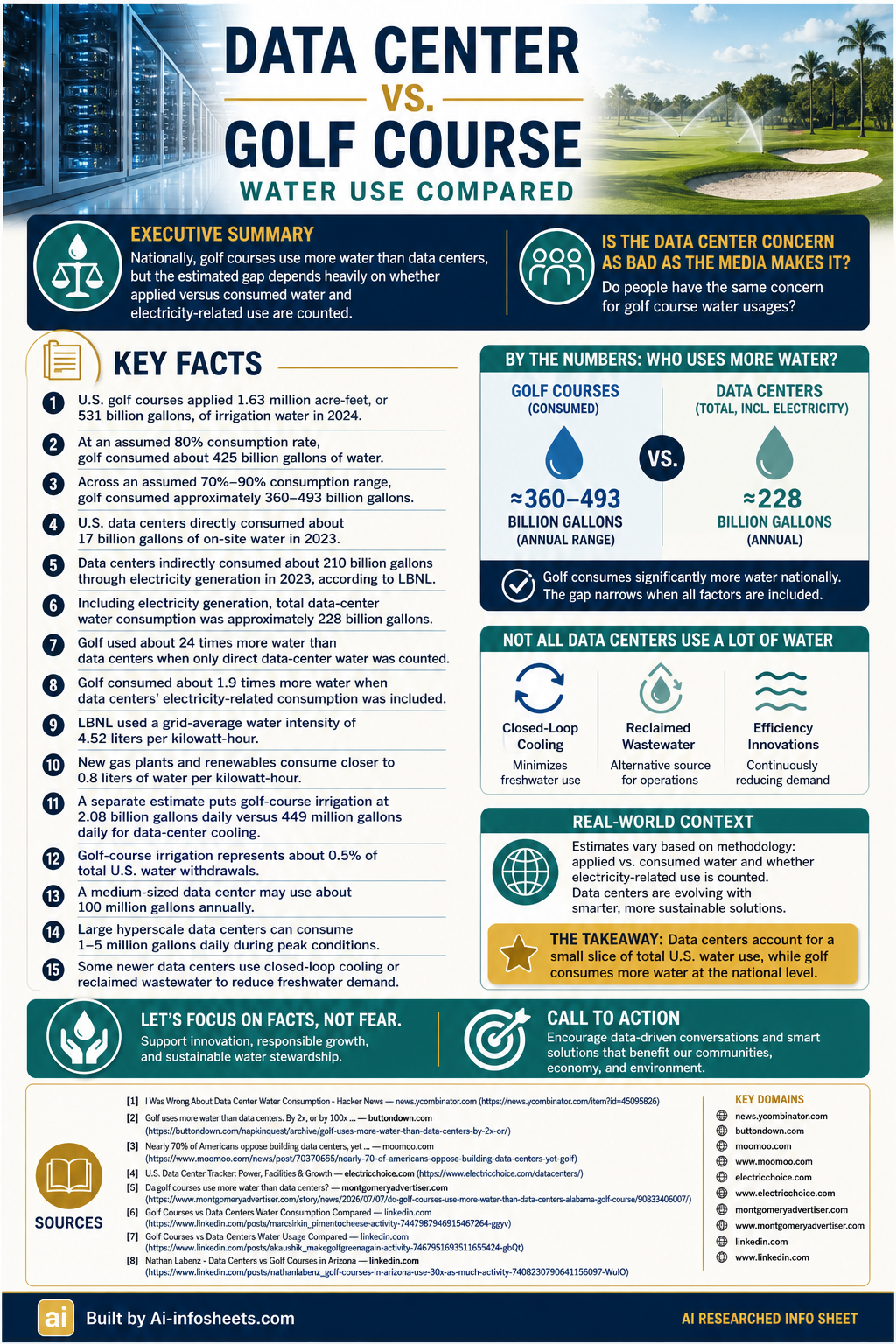
U.S. golf courses applied an estimated 1.63 million acre-feet, or 531 billion gallons, of irrigation water in 2024. [1, 3] While this represents the total applied water, actual consumption, where water is removed from the local water cycle, is a key factor. At an assumed 80% consumption rate, golf courses consumed approximately 425 billion gallons of water. [2, 3] Considering a range of 70% to 90% consumption, the estimated total consumed water by golf courses annually falls between 360 billion and 493 billion gallons. [2, 3] This substantial usage makes golf course irrigation account for about 0.5% of total U.S. water withdrawals. [5]
U.S. Data Center Water Consumption
Data centers are the backbone of our digital world, but their cooling systems can be water-intensive. However, it's important to distinguish between direct on-site water use and indirect water use associated with electricity generation.
Direct On-Site Water Use
In 2023, U.S. data centers directly consumed about 17 billion gallons of on-site water. [1, 4] This figure primarily accounts for water used in cooling systems, which can vary significantly based on the type of cooling technology employed. A medium-sized data center might use around 100 million gallons annually. [5] For larger facilities, hyperscale data centers can consume between 1 million and 5 million gallons daily during peak conditions. [5]
Indirect Water Use from Electricity Generation
Beyond direct consumption, data centers also have an indirect water footprint stemming from the electricity they consume. Powering these facilities requires vast amounts of energy, and conventional power generation (e.g., thermal power plants) often uses water for cooling. In 2023, data centers indirectly consumed an estimated 210 billion gallons of water through electricity generation, according to LBNL. [1, 4] When this indirect consumption is factored in, the total estimated water consumption for U.S. data centers rises to approximately 228 billion gallons annually. [1, 4] This estimate uses a grid-average water intensity of 4.52 liters per kilowatt-hour. [1, 4] Newer power sources, such as gas plants and renewables, typically have a much lower water intensity, closer to 0.8 liters per kilowatt-hour. [1, 4]
The Comparison: Who Uses More Water?
Comparing the water footprints of data centers and golf courses reveals different insights depending on the scope of the comparison.
Direct vs. Total Water Footprint
When only considering direct on-site water consumption, golf courses use significantly more water than data centers—about 24 times more. [1, 4] However, when the indirect water use for electricity generation for data centers is included, the gap narrows considerably. In this comprehensive comparison, golf courses still consume more water nationally, but the ratio drops to about 1.9 times more than data centers. [1, 4] Another estimate indicates that golf course irrigation amounts to 2.08 billion gallons daily, while U.S. data center cooling consumes 449 million gallons daily. [5]
Innovations in Data Center Water Management
Not all data centers consume water indiscriminately. The industry is actively pursuing solutions to reduce its water footprint.
Sustainable Cooling Strategies
Many newer data centers are implementing advanced cooling technologies to minimize freshwater usage. These include closed-loop cooling systems, which recirculate water, significantly reducing the need for constant replenishment. [5] Another approach involves using reclaimed wastewater as an alternative source for operations, decreasing reliance on potable water. [5] Continuous efficiency innovations are also being developed to reduce water demand across the board. [5] While evaporative cooling is more energy-efficient, it does consume significantly more water, underscoring the trade-offs involved in data center design and operation. [5]
Conclusion
The water usage of both data centers and golf courses is a significant environmental consideration. While golf courses consistently consume more water nationally, particularly when focusing on direct usage, data centers' total water footprint, including electricity generation, is substantial and growing. The conversation around water stewardship must be data-driven, acknowledging the varying methodologies for measurement and promoting innovative solutions in both sectors. Supporting responsible growth and sustainable practices will be key to managing our precious water resources effectively for the benefit of communities, the economy, and the environment.