
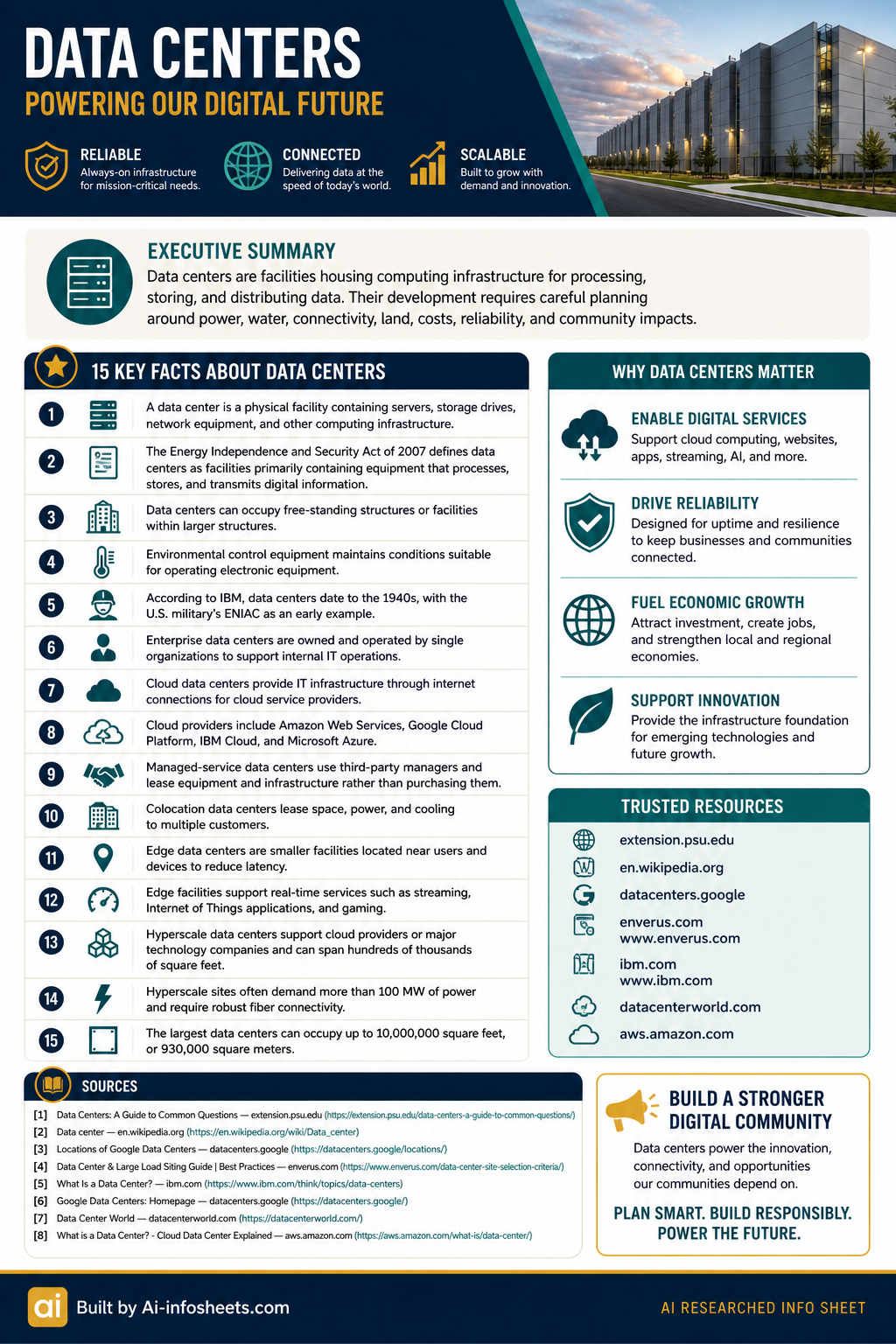


Data centers are the unseen bedrock of our digital existence, serving as physical facilities that house the computing infrastructure essential for processing, storing, managing, and distributing digital data. They are fundamental to virtually every online service, from streaming videos and social media to cloud computing and artificial intelligence. The intricate development of these facilities demands meticulous planning, considering critical factors such as power, water, connectivity, land use, operational costs, reliability, security, and their broader impact on surrounding communities. Understanding the diverse functions and evolving nature of data centers is key to appreciating their role in our increasingly interconnected world.
Physical Infrastructure
A data center is fundamentally a physical facility containing servers, storage drives, network equipment, and other computing infrastructure. These facilities provide the necessary environment for electronic equipment to operate optimally, housing the backbone of our digital information. The Energy Independence and Security Act of 2007 defines data centers as facilities primarily containing equipment that processes, stores, and transmits digital information, underscoring their critical function in the information age.
Structure and Environment
Data centers can be free-standing structures specifically designed for their purpose or can be housed within larger buildings. Regardless of their physical form, environmental control equipment is crucial for maintaining conditions suitable for operating sensitive electronic equipment. This includes managing temperature, humidity, and airflow to prevent overheating and ensure consistent performance.
Historical Context
According to IBM, the concept of data centers dates back to the 1940s, with the U.S. military's ENIAC serving as an early example of large-scale computing infrastructure. This historical perspective highlights the long-standing need for centralized computing power, which has continuously evolved into the sophisticated data centers we know today.
Enterprise Data Centers
Enterprise data centers are typically owned and operated by a single organization. Their primary purpose is to support the internal IT operations of that specific entity, managing its data, applications, and services exclusively.
Cloud Data Centers
Cloud data centers provide IT infrastructure through internet connections, serving as the foundation for various cloud service providers. These centers allow businesses and individuals to access computing resources, storage, and applications on demand, without the need to own and maintain the physical hardware themselves.
Major Cloud Providers
Leading cloud providers leveraging extensive data center networks include Amazon Web Services, Google Cloud Platform, IBM Cloud, and Microsoft Azure. These companies operate vast data center facilities globally, offering scalable and reliable cloud services to millions of users and organizations worldwide.
Managed-Service Data Centers
Managed-service data centers involve third-party managers who operate and maintain the infrastructure. Customers lease equipment and services rather than purchasing and managing the hardware themselves, benefiting from specialized expertise and reduced operational burdens.
Colocation Data Centers
Colocation data centers lease space, power, and cooling resources to multiple customers. This model allows businesses to house their own servers and networking equipment in a secure, professionally managed facility, sharing the costs of infrastructure while maintaining control over their hardware.
Edge Data Centers
Edge data centers are smaller facilities strategically positioned near users and devices. Their proximity helps reduce latency, enabling faster response times for critical applications and services. These localized data centers are vital for modern real-time data processing.
Real-Time Service Support
Edge facilities are instrumental in supporting real-time services such as streaming, Internet of Things (IoT) applications, and online gaming. By bringing computing power closer to the end-users, edge data centers ensure quicker data transmission and processing, enhancing user experience and enabling new technological capabilities.
Hyperscale Data Centers
Hyperscale data centers are massive facilities that support cloud providers or major technology companies. These centers can span hundreds of thousands of square feet, offering immense processing and storage capabilities. They are designed for extreme scalability and efficiency to handle vast amounts of data and traffic.
Power and Connectivity Demands
Hyperscale sites often require significant power, demanding more than 100 megawatts (MW) of electricity, and necessitate robust fiber connectivity to handle their colossal data transfer needs. These facilities are built with advanced cooling systems and redundant power sources to ensure continuous operation.
Scale of the Largest Data Centers
The largest data centers are truly colossal, capable of occupying up to 10,000,000 square feet, which translates to approximately 930,000 square meters. This immense scale highlights the extraordinary infrastructure required to support the global digital economy.
Data centers are foundational to our modern world, enabling everything from simple web browsing to complex AI applications. As technology continues to advance, their role will only grow, necessitating ongoing innovation in their design, efficiency, and sustainability. Supporting these vital hubs responsibly ensures a robust and connected digital future for everyone.