
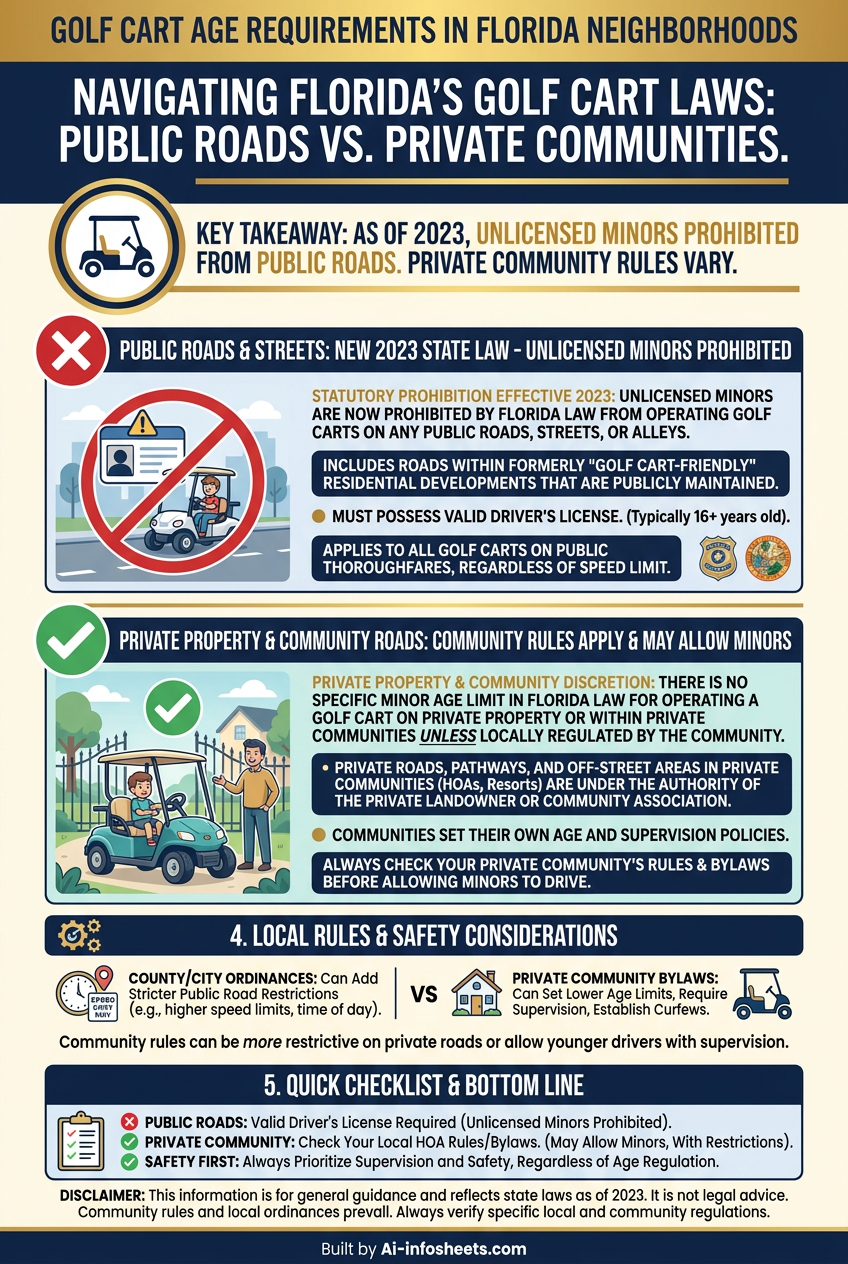


Operating a golf cart in Florida involves understanding a nuanced set of regulations that often depend on where the vehicle is being driven. While many people associate golf carts with leisurely rounds on the green, their increasing use for short-distance travel in residential areas necessitates a clear grasp of state laws and local ordinances. This guide clarifies the age requirements, safety standards, and distinctions between public and private property operation for golf carts across the Sunshine State.
State of Florida Golf Cart Regulations on Public Roads
Florida state law clearly defines the requirements for operating a golf cart on designated public roads. According to Florida Statute 316.212, a golf cart is a motor vehicle that is ^{"claim":"designed for operation on a golf course and is not capable of exceeding on a level surface a speed of 20 miles per hour (32 kilometers per hour)","sourceIndex":0}. When operating on public roads, golf carts are generally restricted to streets where the posted speed limit is ^{"claim":"25 miles per hour (40 kilometers per hour) or less","sourceIndex":0}. Drivers must adhere to all standard traffic laws.
Age Requirements for Public Road Operation
Florida law specifies that a person operating a golf cart on a public road must be at least ^{"claim":"14 years of age or older","sourceIndex":0}. Importantly, this regulation does not require the driver to possess a valid driver's license, learner's permit, or official state-issued identification. The ^{"claim":"age requirement of 14 years or older","sourceIndex":0} is the sole state-level age restriction for public road use of golf carts, provided the road is approved for golf cart traffic.
Required Equipment for Public Road Golf Carts
Golf carts driven on public roads in Florida must be equipped with essential safety features. These include ^{"claim":"reliable brakes, a rearview mirror, and efficient steering apparatus","sourceIndex":0}. For operation during nighttime hours, they must also have ^{"claim":"headlights, taillights, brake lights, and turn signals","sourceIndex":0}. These requirements are in place to ensure the safety of both the golf cart occupants and other vehicles on the road.
Golf Cart Operation in Private Communities and on Private Property
The regulations governing golf cart use can differ significantly when moving from public roads to private property, such as gated communities, retirement villages, or private residential developments. Florida state law primarily pertains to public roadways and does not generally extend its specific age or licensing requirements to private lands.
Absence of State Age Law for Private Property
Crucially, ^{"claim":"Florida state law does not impose an age requirement for operating a golf cart on private property","sourceIndex":1}. This means that within the confines of a private community or on private land, there is no state-mandated minimum age for a child to drive a golf cart. This distinction is often a source of confusion for residents and visitors.
Community-Specific Rules and Regulations
While the state does not dictate age limits on private property, many private communities, homeowners' associations (HOAs), and property owners implement their own rules. These community guidelines ^{"claim":"can vary widely","sourceIndex":2} and may include minimum age requirements (e.g., 12 or 16 years old), restrictions on unsupervised child operation, or even requirements for adult supervision. It is imperative for residents and guests to consult their community's specific bylaws and regulations regarding golf cart usage to ensure compliance and safety.
Importance of Safety on Private Property
Even without state-mandated age limits on private property, safety should remain the highest priority. Golf cart accidents can result in serious injuries. Parents and supervisors should ensure that young drivers are capable of safely operating the vehicle, understand its controls, and are aware of potential hazards. Key safety practices include operating at appropriate speeds, avoiding distractions, and ensuring all occupants are seated properly. Community rules often emphasize these safety aspects to prevent incidents.
Understanding Florida's golf cart laws is essential for safe and legal operation. Always differentiate between public roads, which are governed by state statute, and private property, where community-specific rules often take precedence. For definitive guidance, consult the Florida Department of Highway Safety and Motor Vehicles and your local community's administration.